

For centuries art has been intimately connected to the cultural zeitgeist. Not just visual artists, but writers, playwrights, actors and filmmakers all produce art that, either poignantly or provocatively, holds a mirror up to society. As the digital age progresses, our idea of art and the means and systems to create it expands. Recent developments of Artificial Intelligence have stirred a plethora of conversations and sparked protests, lawsuits, and movements throughout many industries demanding for regulations around artificial life. The Writers Guild of America (WGA) and SAG-AFTRA (Screen Actors Guild - American Federation of Television and Radio Artists) strikes in 2023 are a prime example. Actors and writers in Hollywood protested for collectively 146 days (WGA started on May 2nd, and SAG-AFTRA joined on July 14) making it the second longest labour stoppage in the industry’s history. One major concern for the industry was the emergence and use of artificial intelligence, and the potential impact on their livelihoods.
Tool, Threat or Creative Partner?
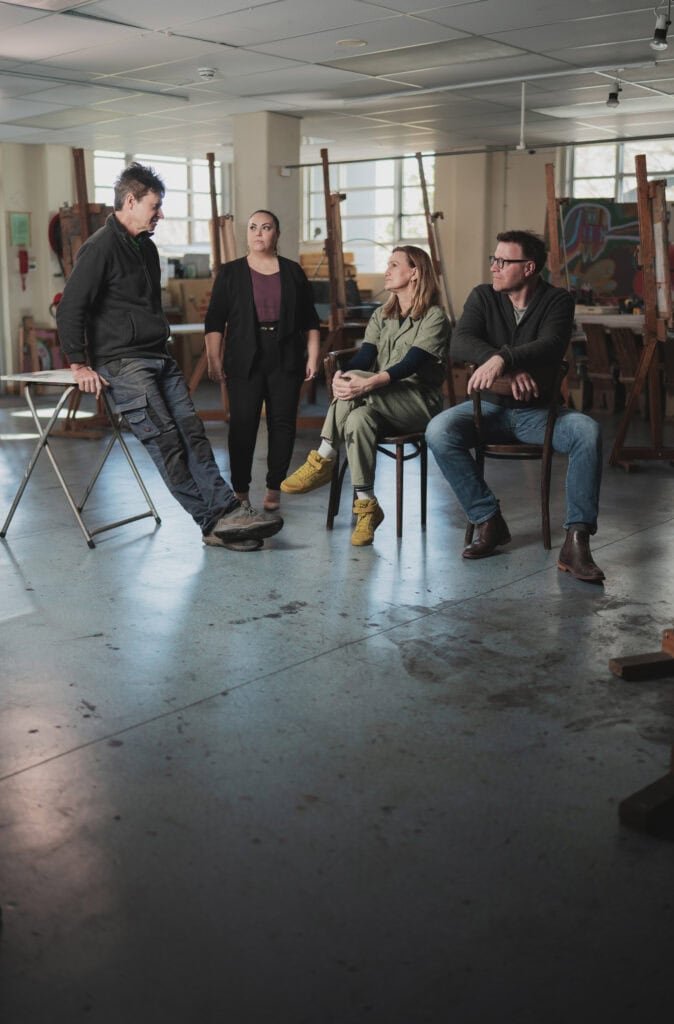
Our relationship with Artificial Intelligence (AI) is ever evolving. The continual advancement of the technology means our interactions with it can change, almost daily. What started as asking Siri to ‘call mum’ evolved to asking Google to ‘turn down the air conditioning’, to now asking Chat to make an itinerary of our three-week Euro vacation, or craft a work email for us. All time saving tasks, but what are the costs of integrating AI into our lives? We spoke with four leading creatives on Avondale University’s academic staff to explore the effects and impact Artificial Intelligence has on creativity, art and our human experience.
“I think modelling ethical use of AI is something we can all do for our kids or for our students or in our workplace – creating a culture of using it only when you need [and] using it carefully… We have no choice but to embrace AI and use it wisely,” says Dr Lynnette Lounsbury, Head of School – Arts and Business. “I have a choice whether I write using AI or not. So that's my choice. I don't have a choice about engaging in a world that has AI in it or not.” Jacqueline Calvo, Business School Lecturer, adds “I would always say that the technology in and of itself is a tool. It's who's wielding it, that you need to be more wary of. We get to steer the ship of where it goes.”
Whether I use it or not, I need to understand it, or I will be fooled by it. I need to use it well, or I am contributing to wasteful destruction
Energy consumption is a major concern around the increased use of AI. The International Energy Agency (IEA) suggests that in 2024 data centres used around 1.5% of the global electricity consumption. Long term environmental impacts of data centres are not yet known, but if the technology rollout continues, electricity demand will increase. The IEA shares that global electricity supply for data centres is projected to rise from ‘460 TWh in 2024 to over 1000 TWh in 2030’. Renewable energy, nuclear and natural coal and gas are all suggestions helping combat the energy crisis. They also suggest that renewables continue to be the fastest growing energy source for data centres and meet close to 50% of their energy demand. But we must ask ourselves, is the draining of our natural resources worth asking ChatGPT what we should make for breakfast with what we have in our fridge? “Whether I use it or not, I need to understand it, or I will be fooled by it. I need to use it well, or I am contributing to wasteful destruction,” says Dr Lounsbury.
Artificial Intelligence: A History
Ideas of Artificial Intelligence date back centuries. Greek mythology foreshadowed artificial life with figures such as Talos, a bronze robot in the form of a man, commissioned to protect the island kingdom of Crete. Jonathan Swift included ‘the Engine’ in his 1726 novel Gulliver’s Travels, the earliest known reference to a device that resembles a computer. While no direct reference is made, the Engine is thought to parody Spanish philosopher and theologian Ramon Llull’s ‘logical machines’ and his theory Ars generalis ultima.
The term ‘artificial intelligence’ was first coined in a proposal by computer scientists John McCarthy, Marvin Minsky, Nathaniel Rochester and Claude Shannon in 1955. In 1956, the following year, the team held a Summer Research Project at Dartmouth College which is generally considered the birth of the new academic discipline, Artificial Intelligence. In 1958, John McCarthy created the computer programming language LISP which became the most popular language programme in artificial intelligence research. For nearly 70 years Artificial Intelligence has developed from human intelligence exhibited in a computer to deep learning machines that now pump out content (Generative AI).
So, what exactly is AI?
Artificial Intelligence models are dependent on learning algorithms that are developed and maintained by data scientists. This means they need human intervention to form responses to new information outside of their initial training. The AI applications that we interact with today are based on traditional machine learning models.
AI can be understood through two categories: AI functionalities and AI capabilities. There are four types of AI based on functionalities: Reactive Machine AI – these produce your Netflix recommendations; Limited Memory AI – this is Generative AI (OpenAI’s ChatGPT), virtual assistants and chat bots (Siri, Alexa, Google etc), and self-driving cars; Theory of Mind AI and Self-Aware AI. If we look at the types of AI based on capabilities, there are three: Artificial Narrow AI, General AI, and Super AI. General and Super AI are nothing but theoretical concepts. If realised, they would be the types of Artificial Intelligence that could reason, learn and have cognitive abilities, like humans. Examples in pop culture of sentient bots would be ‘Rosey’ the robot as seen in The Jetsons and ‘HAL 9000’ in 2001: A Space Odyssey.
Only Artificial Narrow AI exists today; it’s not going to rise up like Skynet, but it might transform how we work. Siri, Alexa and even ChatGPT are all forms of Narrow AI as they are limited to perform singular tasks. While these chatbots return the thanks for a task we thank them for doing, they are only doing so because of human input, but they are not sentient.
Using chatbots as search engines is increasing in popularity however Calvo notes that not all bots have the same capabilities. “ChatGPT uses Bing [which] only holds around, 2 or 3% of the market share – their answers from a search perspective are not great” she explains. “Google's version that they have now completely rolled out, Google AI overview, I think [is] going to give ChatGPT a massive run for their money because they've already had the mass market share and [you] don't have to go into a different program to actually get answers.”
The intersection of art, technology and knowledge
The invention of photography in the 1800s had some artists claiming it the antithesis of the artist. While considered a threat to the status quo, photography didn’t overtake painting but became the catalyst for the experimental modern art movement of the 20th century. “They had to create a path of distinction,” explains Dr Richard Morris, Senior Lecturer of Creative Arts. “They had to create a justification for why to continue painting. So, there was the idea of pointillism and then impressionism. In the '60s when photography was abounding, they got into realism again. It made a resurgence, and it was probably more to do with the craft.” The photographs development led to the contemporary art we consume today. “All new technologies that come along, at first, they're a novelty and they're a threat.”
The arts often intersect with other industries and movements. Art movements such as Surrealism – think The Son of Man by René Magritte – burgeoned from the Dada movement of 1916 and is characterised by its bizarre, dreamlike and illogical imagery. Artists in the movement found inspiration from the uncanny and challenging the imposed norms. The surrealists use of the uncanny came from Psychologist Sigmund Freud’s essay. Artists used his definition – of something feeling familiar yet alien at once – by combining familiar things in unexpected ways.
AI might facilitate creativity toward a place it’s never been, but a commonality of art is its process and creation which stems from wrestle and risk
What are the effects of incorporating AI into the practice of art?
In the same way a camera takes an image for the artist, AI generates art for the artist. “[AI art] is still filtered through humans because there's no bot sitting there spitting out films, paintings and poems. They only come out when asked by a programmer or asked by a human who's using the program. There’s still human input to trigger the process” says Dr Lounsbury. “Pros of Generative AI is that it does democratise access to data,” explains Calvo. “It does democratise some of the creative aspects where people who aren't naturally, perhaps creative, can go through an ideation and prototype process a lot easier without having to use specialised experts in that area.”
AI might facilitate creativity toward a place it’s never been, but a commonality of art is its process and creation which stems from wrestle and risk. If the artist hasn’t been through that process of creation, then is the final artefact – novel, painting, film and so on – meaningful? “Ultimately, art is just as much about the journey as it is about the destination. And if you haven't gone through the struggle, have you really created art?” questions Jim Lounsbury, filmmaker and Academic for Creative Arts at Avondale. “The humanness is understanding that struggle and understanding that we each go through it. So, if you cheat yourself out of the human experience, then what's the purpose?”
“I suppose it's an area of life that really doesn't make a lot of sense, in that it doesn't feed people. It doesn't build homes. It doesn’t have a pragmatic basis. But without art, our lives would be incredibly impoverished” says Dr Morris. “Art is one of those things that celebrates our humanity, who we are as creative individuals – I believe that we've been created that way.”
Ancient art (4000BCE – 400CE) was produced by advanced civilisations such as Mesopotamia, Egypt, Greece and some of the Americas. These civilisations all used art for similar purposes, such as decorating utilitarian objects like crockery and weapons, to tell stories, demonstrate societal status and religious imagery. There was a purpose to it, a usefulness that has translated into today’s culture. Art, in all its forms, still tells stories, but has the commercialisation undermined its impact in society? “I've often said that advertising stole all the poets in this generation.” Lounsbury continues, “so, I think commerce has rendered a lot of creative minds somewhat banal and uninteresting, because now they're chasing commerce rather than chasing originality. Or they're trying to manufacture originality for the sake of commerce.”
If creative minds are being siphoned into commerce, and AI is encroaching on the creative industry, can meaningful, valuable art still exist. “If you [take that] away from a person, the ability to express themselves and to create, you're diminishing who they are as a person. You're reducing them to just a life form. And I think that we're much more than that” says Dr Morris.
“[Meaning is] what life's all about. It's about doing things that count, doing things that are important.” When identifying and connecting with peoples artforms, Dr Morris uses ceramics as an example, “[understanding that it’s] not just something that a machine has poked out of a pug mill onto a conveyor belt and then [glazed] and it goes into a kiln. But it's somebody who's chosen this as a way of life and even as a way of hardship. They've embraced the difficulty of that whole process as something that they value and it's something that they want to hold on to, and they don't want to lose.”
Human intelligence landed us here today. Great, curious minds such as William Shakespeare advanced the English language; we have light bulbs and motion pictures thanks to Thomas Edison; we can attempt to understand the universe because Galileo laid the groundwork for modern science, meaning Isaac Newton could realise the Laws of Motion. Their work continues to ripple throughout our existence today, despite their controversy during their time. “People are scared of new things,” explains Dr Lounsbury, “I think there's a portion of society that absolutely runs at new things and loves [them], and then there's this majority who are scared and don't know what to do with it. It was the same with the internet. People thought it was the end of everything, and it certainly wasn't. But it brought problems, and maybe if we embrace things in a new way, we can avoid problems more effectively, than we did then.”
Calvo explains the most interesting factor is that AI is creating new consumer behaviours. “We're going to see more products integrate these types of AI as part of their augmented products that are offered to customers,” she explains. “So, it's going to [create] certain expectations that consumers expect when we're using products and services.” Cons to increased use of Artificial Intelligence are deep fakes. “[They are] going to cause issues” she says. “People perhaps are now lacking the skills or aren't understanding that new skills need to be created around the critical eye of how we view and how we use AI tools. [It’s] something that needs to be talked [about] at various levels, in terms of how we deal with the spread of potential misinformation.”
So, is our own human interaction and response with GenAI what makes it a positive or a negative? Perhaps it’s our own guilt or our own fantasy that warps the narrative. Maybe it’s our greed. So, are we the problem, not AI?
“Yes, are we the problem. AI is just a machine – machines have malfunctions. People have problems,” says Dr Morris.
“Humanity is always the problem and the solution,” adds Dr Lounsbury. “We tend to, and this is DNA level humanity, try and make things easier, [and] less work for ourselves – even if it’s just the fun, emotional work of creating. It's still work; it's still tiring.”
“I always come back to the person who's using the tools and the intent behind it,” comments Calvo. “Also from a communication model perspective, you may have encoded the message to come across [one] way, but people [might not be] decoding it in that way... So, governance, is the next big issue when it comes to the likes of deep fakes and how we might be using AI in particular ways.”
“AI just adds fuel,” Lounsbury concludes. “Technology adds fuel to whatever is the prevailing trade winds of our trajectory as human beings.”
The age-old adage of ‘ignorance is bliss’ should not be a badge of honour we wear proudly. Ignorance is a weapon used by many systems throughout history, which can cost us our agency. It is also a choice. Knowledge is power, especially when it comes to artificial intelligence. Knowing the capabilities and when to spot AI generated content is pivotal in reducing the spread of mis and disinformation. We can’t fake fluency; foresight and education bring confidence in a field that changes and attempts to mislead us daily. Ethical and responsible use needs to be our approach when it comes to Generative AI; if it’s not, there are detrimental cognitive, environmental, and economical effects. Shutting it out is not the answer.
As multifaceted as life can be, when we break it down into tasks, it’s completely binary; there’s joyous tasks and mundane ones – they look different to all of us. If artificial intelligence is taking away the joy of being human, of being creative, then we ourselves are left to complete the mundane. It’s a hollow promise that it’s here to help us create authentic art. It’s a current that can rip us out to sea. So, knowing its capability isn’t submission, it’s action. It’s swimming with the tide so we don’t drown.