

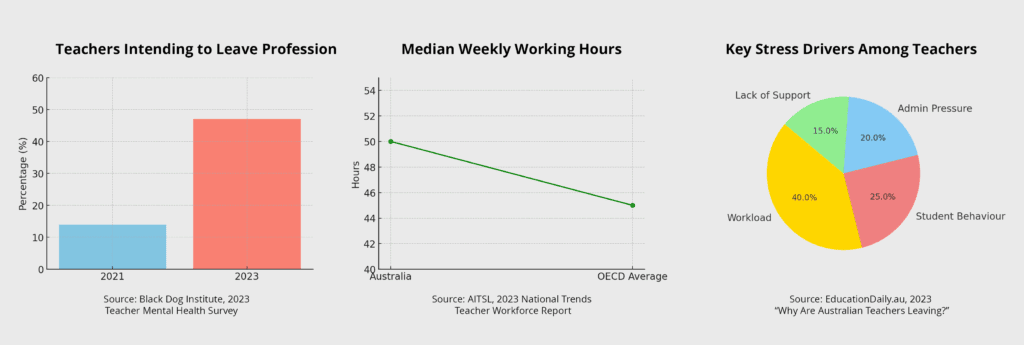
The teaching profession is facing a health and wellbeing crisis, with more and more teachers reporting a desire to leave the profession. 47% of Australian teachers consider leaving within their first year, according to a survey of over 4000 teachers conducted by Black Dog Institute in 2023, up sharply from 14% the previous year1. Data from the same study also showed 60% of teacher absences in the previous month were due to a mental health or emotional problems.
47% of Australian teachers consider leaving the profession within the first year.
The confronting reality is that teacher wellbeing doesn’t only affect teachers. It can also have a profound impact on students’ academic and emotional outcomes, not to mention the wellbeing of parents and the extended community.
Without a systemic response to this crisis, schools risk not only losing valuable staff but also eroding the wellbeing of those who remain.
The Dual Nature of Teacher Burnout
At its core, teacher burnout encompasses both emotional fatigue and physical strain, which have been well documented in occupational stress research.
Emotional fatigue stems from chronic stress, high-stakes responsibilities, and the unrelenting emotional labour of teaching. Educators are not only instructors—they are mentors, counsellors, and caretakers, often navigating complex student needs with limited support. Over time, this constant emotional engagement without sufficient recovery leads to exhaustion, detachment, and a reduced sense of professional efficacy—a clinical profile recognised in occupational health as burnout syndrome.2
Compounding this is the physical toll of teaching. Occupational stress research links high-stress environments to a range of physical health issues, including musculoskeletal disorders, cardiovascular disease, and weakened immune function3. Teachers frequently report chronic fatigue, sleep disturbances, and tension-related ailments—all exacerbated by long hours, limited breaks, and the constant demands of managing a classroom.
Systemic Challenges Fueling the Crisis
This epidemic of burnout doesn’t occur in a vacuum—it’s the result of systemic pressures that continue to grow in intensity.
- Excessive Workload
Teachers routinely work beyond contracted hours, arriving early, staying late, and spending weekends planning lessons and grading. A 2023 survey by the Black Dog Institute found that 85% of teachers arrive early or take work home, with 70% reporting their workload as unmanageable.
- Rising Student Behaviour Challenges
Managing classroom behaviour has become increasingly difficult, with teachers facing more complex student needs, limited support staff, and inconsistent disciplinary policies. These daily stressors erode morale and heighten emotional fatigue.
- Administrative Expectations
The burden of non-teaching tasks—paperwork, compliance reporting, data entry—has ballooned in recent years. Many teachers report that administrative demands now take up as much time as actual teaching, leaving little room for creativity or connection in the classroom.
- Lack of Support and Recognition
Despite the onerous demands of their jobs, teachers often feel undervalued and unsupported. Inadequate access to mental health resources, insufficient time for collaboration, and a lack of professional autonomy all contribute to a sense of isolation and frustration.
These systemic challenges can drive once passionate educators to the brink, and beyond. Without meaningful intervention, schools risk losing not only individual teachers but the institutional knowledge, community connection, and student outcomes that experienced educators bring.
The Human Cost
The toll of teaching extends far beyond the classroom. Chronic stress leads to emotional exhaustion, often manifesting as absenteeism, reduced motivation, and, ultimately, resignation. Teachers consistently report feelings of being overwhelmed and undervalued, leading many to leave the profession prematurely.
Beyond emotional fatigue, physical health also deteriorates under sustained pressure—research by the National Institute for Occupational Safety and Health links workplace stress to musculoskeletal pain, cardiovascular disease, and immune suppression4. Studies have also shown a strong correlation between chronic occupational stress and the development of anxiety, depression, and burnout5. These issues don’t just affect individual teachers—they undermine school cohesion, student outcomes, and long-term educational quality.
So what can school leaders do in the face of this crisis?
Focus on What You Can Control
Not all systemic challenges—like government policy, funding shortfalls, or national curriculum demands—are within the immediate control of school leaders. However, there are meaningful, evidence-based steps that administrators and wellbeing coordinators can take to mitigate the stressors teachers face daily. School culture, leadership tone, and the prioritisation of staff wellbeing are powerful levers. Creating space for open conversations about mental health, embedding wellbeing practices into staff routines, and offering supportive professional development opportunities are all within reach.
While the broader education landscape may be slow to shift, the microclimate of a single school can change dramatically when staff feel seen, supported, and valued. In times of overwhelming pressure, focusing on what you can control is not just practical—it’s empowering.
Prioritise Culture, Connection and Wellbeing
Psychosocial safety climate (PSC) theory posits that when school leaders actively prioritise mental health and wellbeing, the results are profound: lower turnover, reduced burnout, and increased engagement. Schools that cultivate a culture of care—where staff wellbeing is embedded into policies and daily practice—see higher levels of retention and job satisfaction, both of which serve as protective factors against burnout and attrition.
When school leaders actively prioritise mental health and wellbeing, the results are profound: lower turnover, reduced burnout, and increased engagement.
Research shows that employees who feel supported in their mental health are more productive, collaborative, and resilient in the face of stress. For schools, this means healthier staff, better teaching, and improved student learning environments. Administrators have both the responsibility and opportunity to lead the way, creating spaces where teachers not only survive—but thrive.
Case Study: St Philip’s Christian College & The Lift Project
St Philip’s Christian College recognised the need to support staff wellbeing holistically. In response, the school implemented The Lift Project—a science-based health and wellbeing program developed by Dr. Darren Morton, a Professor at Avondale University—with their entire staff. During weekly staff meetings, teachers watched short, engaging video lessons together and were invited to take part in optional wellbeing challenges each week. The initiative quickly became a culture-builder: staff bonded over shared goals, friendly competition, and practical strategies for improving mood, energy, and resilience. Testimonials from the administrators and teachers alike, highlight how the program lifted morale, fostered connection, and made wellbeing an integral part of the school’s identity.
“Doing The Lift Project has helped me be more present in my classroom,” said Chloe Edwards, a teacher who went through the program, “having those intentional cues to go outside or take a moment really just makes you feel happier—and your class is getting a better version of you.”
By embedding The Lift Project into routine staff development, St Philip’s not only improved wellbeing but also demonstrated executive support in a tangible and meaningful way.
Call to Action for Administrators
The wellbeing of teachers cannot be treated as an afterthought—it is the foundation of effective teaching, school culture, and student success. Administrators must lead by prioritising staff health through structured, evidence-based initiatives like The Lift Project.
By embedding wellbeing into regular routines—through staff meetings, professional development, and leadership modelling—schools create environments where teachers feel valued, supported, and engaged. The next step is simple: pilot a wellbeing program, allocate resources, monitor outcomes, and ensure leadership remains actively involved. Schools that invest in their people today will see better retention, morale, and learning outcomes tomorrow.
From Burnout to Breakthrough
The teacher wellbeing crisis is real—but there are practical steps school leaders can take to address the stress their teachers may be facing. This is why Avondale University is taking the lead by providing structured initiatives to help schools turn the tide: building culture, connection, and resilience.
“As educators, we are continually giving of ourselves for others,” says Kelly Morton, a teacher at Avondale High School, “but you can’t pour from an empty cup. The Lift Project provides a knowledge base, along with practical strategies, to be able to care for yourself. Caring for our own health and wellbeing is not selfish, it is what allows us to be our best selves and keep showing up for others.”
The message is clear: investing in teacher health is not just compassionate—it’s the smartest long-term strategy for staff retention and educational success.
Thank you so much for putting together a world class project which has been of inestimable value to our staff. We have received, and continue to receive, outstanding feedback from our staff on the ways The Lift Project has improved their outlook and general sense of wellbeing.
Len Farquharson, Head of Campus
Gilson College, Taylors Hill
Bibliography
1 Black Dog Institute. (2023, October 5). Teacher mental health and burnout could halve workforce: New data by Black Dog Institute. https://www.blackdoginstitute.org.au/media-releases/teacher-mental-health-and-burnout-could-halve-workforce-new-data-by-black-dog-institute/
2 Maslach, C., Jackson, S. E., & Leiter, M. P. (1997). Maslach Burnout Inventory manual (3rd ed.). Consulting Psychologists Press. https://search.worldcat.org/title/Maslach-burnout-inventory-manual/oclc/256801512
3 National Institute for Occupational Safety and Health. (2021). Stress at work. U.S. Department of Health and Human Services, Centers for Disease Control and Prevention. https://www.cdc.gov/niosh/docs/99-101/
4 Madigan, D., Glandorf, H., Kavanagh, O., & Kim, L. (2023). Teacher burnout and physical health: A systematic review. International Journal of Educational Research. https://www.researchgate.net/publication/369600942_Teacher_burnout_and_physical_health_A_systematic_review
5 Agyapong, B., Obuobi‑Donkor, G., Burback, L., & Wei, Y. (2022). Stress, Burnout, Anxiety and Depression among Teachers: A Scoping Review. International Journal of Environmental Research and Public Health, 19(17), 10706. https://www.mdpi.com/1660-4601/19/17/10706