

Avondale University’s Bachelor of Arts (Creative Arts) was recently recognised as Australia’s top undergraduate Creative Arts course for overall educational experience, according to 2024 QILT data. Behind that result is a close-knit community of students and lecturers who see creativity not as an extracurricular passion, but as a fundamental way of understanding and shaping the world. While universities often speak loudly about research, creative practice can be less visible in those conversations - even as it sits at the very top of Bloom’s Taxonomy as the highest level of educational achievement. At Avondale, we take creative practice seriously. We use research to frame, inform, and elevate it, and in turn, creative practice allows us to communicate our research with impact, reach, and imaginative insight.
Bringing together Creative Writing and Communications, Music, Humanities, Visual Arts and Visual Communication, the program blends artistic development with professional application, giving students a space to explore who they are and how their creative work connects to wider social and cultural contexts. Here, lecturers are not only teachers but active creators themselves, using their own ongoing creative practice as a way to learn, grow, and continually refine the craft they pass on to their students.
Music
Dr. Aleta King, Director of Music at Avondale’s Conservatorium, speaks about her program with quiet confidence. For her, excellence in music comes from connection - between theory and performance, students and mentors, individuals and community.
“The Avondale Conservatorium music program is committed to fostering excellence by providing students with opportunities to be mentored by some of Australia’s best practicing music industry professionals,” she says. “Students have many outstanding opportunities to hone their performance skills in choir, orchestra, band, or chamber ensemble collaborations - as soloists or ensemble performers in classical, contemporary, jazz, musical theatre, and sacred worship contexts.”
Unlike larger conservatoriums, Avondale’s smaller size allows for what King describes as a “bespoke approach” to learning. “A small cohort means less competition and more opportunities for students who are keen and show initiative,” she explains. “It also enables a very individualised approach to mentoring. Every student’s journey looks a little different.”
Community performance is central to the experience. “Our performance opportunities are open to the public, which enables real and meaningful engagement,” she says. “It’s a distinctive feature of the program.”
That engagement extends well beyond the local stage. In 2024, The Promise of Avondale, the university’s vocal ensemble, toured New Zealand to compete in the World Choir Games, performing alongside choirs from across the world. “It provided incredible opportunities for cultural and musical collaboration,” says King.
Avondale’s music students engage with both classical and contemporary traditions, grounded by what King calls “music literacy”, “the ability to think intelligently in sound.” Students develop this literacy through an integrated pedagogical approach that combines “ears, eyes, brains, hands, and hearts,” exploring everything from Western classical traditions to film music, jazz, Australian Indigenous and world music.
A commitment to one-on-one lessons with professional tutors remains a cornerstone of the program. King notes, “Without a doubt, the solo performance program is an outstanding feature and a great strength of Avondale Conservatorium's music program.” Recent musical theatre productions have also allowed students to collaborate with professionals across the creative industries, integrating dance, fine art, and music production; a reflection of the program’s broader commitment to interdisciplinary learning.
Visual Arts and Visual Communication
For Visual Arts lecturer Dr. Richard Morris, art education at Avondale is as much about cultivating curiosity as it is about technical skill.
“The Visual Arts program has a commitment to digital engagement,” he says. “Through specific units, students learn how to use digital platforms such as Photoshop, InDesign, and Premiere Pro for a variety of tasks over the course of their studies.”
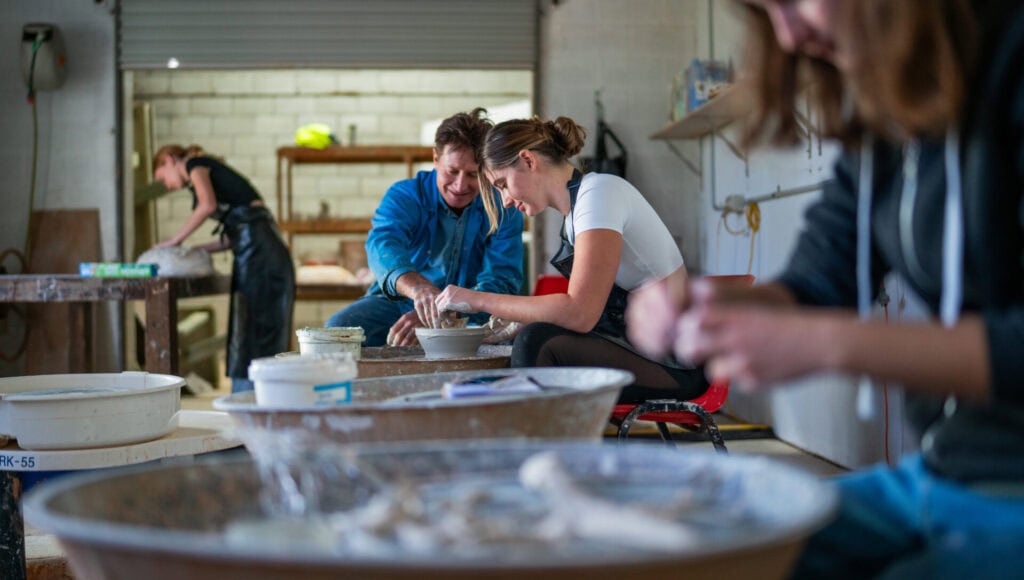
Students work across both digital and traditional mediums, producing still, video, and interactive works alongside painting, sculpture, ceramics, and photography. Each student builds a digital portfolio and maintains a visual arts diary, a record of both creative process and artistic growth.
“Visual storytelling is important today because the human mind processes visual stimuli faster than text,” says Morris. “It leads to more immediate engagement and emotional connection, and it bridges language barriers. Making artwork that tells stories also teaches students to think critically about their creative choices and the messages they want to convey.”
Industry connections are woven into the curriculum. Students visit major and regional galleries including the Art Gallery of NSW, the Museum of Contemporary Art, and Maitland Regional Gallery, among others. These excursions give students a sense of professional practice and an understanding of how art operates in public and cultural spaces.
One graduate, Angela Miller, now a guest lecturer, exemplifies the program’s ethos. A practicing visual artist and painter, Miller’s professional success offers a tangible model for current students exploring life after graduation.
For Morris, the greatest satisfaction comes from witnessing transformation. “It’s like the lights come on for them,” he says. “You can see the momentum grow as they find something they’re passionate about. That moment of artistic satisfaction, it’s pure joy.”
Avondale’s small classes, he adds, make that kind of growth possible. “They allow personalised attention and foster individual artistic voice,” he says. “Students get detailed feedback and learn not only from their teachers but from each other. It’s collaborative and deeply human.”
Looking ahead, Morris envisions “a place of delight and visual experimentation” for the department. “Given our smaller size, we can move quickly in directions students are interested in,” he says. “That flexibility is exciting. I’d like to see a deepening and enrichment of experiences rather than just growth in numbers.”
Creative Writing and Communications
For more than a decade Associate Professor Carolyn Rickett designed and convened the creative writing unit at Avondale providing opportunities for students to collaborate with high profile poets. There were several anthologies published by the renowned literary publisher Puncher & Wattmann and central to this community of practice were internationally recognised poets Judith Beveridge, Jean Kent and academic and creative practitioner Dr David Musgrave serving as mentors. First-time student poets valued having their work recognised and promoted alongside experienced writers. Judith Beveridge notes on one of the anthology’s covers that “… providing a space for new poets to see their poems within a wider context… opens windows and vistas and gives new poets diverse and prestigious voices against which to test their own poems and recognise the value of beautiful and finely articulated speech.”
Rickett observes that “creative writing (and by logical extension reading) is a means of expansion… poetry praxis provides an opportunity to draw on divergent life experiences to distil and re-imagine those for an engaged reader… to be part of a process where students learn to use words as a way to make meaning is a privilege.” She believes poetry's attention to language and its revelatory power remains unrivalled by other written forms. Central to the teaching-research nexus of creative practice is the concept of working in a collaborative context to (re) generate and create something new. Embedded in the scholarship of our first poetry anthology Wording the World, and central to Rickett’s own professional practice and teaching philosophy for the Arts, is Howard Nemerov’s idea of poets (and students) not simply using words to identify and name, but also further the ontological impulse for truth seeking:
They were the ones that in whatever tongue
Worded the World, they were the first to say,
Star, water, stone, that said the visible
And made it bring invisibles to view …
In recent years Dr. Lynnette Lounsbury has led the discipline and for her, storytelling is both an art and a skill that prepares students for an increasingly communication-driven world.
“We have a small program at Avondale and so we are lithe and able to move quickly, adding new publication pathways for students and creating opportunities to engage with professionals in their field,” she explains. “As a smaller program, lecturers and students know each other well. We’re aware of their strengths and areas of interest, so we can invite them to contribute stories, poetry and articles that we know will be areas of passion for them.”
Those opportunities are practical as much as creative. Students publish their work across several platforms, including NICHE (an online zine for first-year students), VOICE (the student paper published four times a year), and VIGNETTE (an annual creative writing journal for staff, students, and alumni). A poetry and short story anthology is also produced every two years, offering hands-on experience in editing, publishing, and collaboration.
For Lounsbury, the benefits of writing go far beyond traditional literary careers. “Being able to write sets students up to communicate well in any job,” she says. “It may be a career where writing is integral, like publishing or public relations, but it might also be the newsletter and website for their own small business, or at a school or non-profit organisation. Telling a story gains you an audience - it’s the best way to connect with people about anything.”
That approach has led many graduates to diverse careers - from published poets and podcasters to journalists working at the ABC and The Sydney Morning Herald, and communications professionals at organisations such as ADRA and the Sydney Opera House.
Creativity, Lounsbury believes, is particularly important in helping students navigate today’s digital world. “Creativity empowers students to think critically and imaginatively about the information that surrounds them,” she says. “It shifts passive consumption into active exploration and innovation. It helps them to question algorithms, to craft authentic narratives, and to use technology as a tool for expression rather than letting it shape their thinking.”
What excites her most about teaching, though, are the moments when students start to see themselves differently. “Watching students start to think of themselves as writers and poets, that’s when it clicks,” she says. “I love to see them experiment with form and find things they are gifted at. Someone who finds writing difficult might shine in the podcast studio. Another might find themselves behind a camera capturing a story. I love seeing their faces when I ask to publish their work to see them know that I believe in their talent is such a life-affirming moment.”
Her hopes for the future of the program are characteristically creative. “A creative arts festival,” she says. “It’s coming.”
Gaming as creative practice in History.
For Modern History lecturer, Dr. Daniel Carrigy, immersion, empathy, and understanding are the core pedagogical tools for teaching history. Carrigy asserts that, “What is really important is that students don’t see history as a bunch of facts, dates, and figures. Good historians are able to recognise the hopes, dreams, anxieties, and fears that drive people throughout history.”
Carrigy has a particular passion for narrative history, and he embeds this creativity in his teaching practice. He explains that he tries to begin each lecture with the simple goal of placing students in the shoes of the people they are examining. “This semester, I adopted a specific approach in Australian history. Before we even examine events or dates, I recount an anecdote from a specific situation in history. This really helps students to situate themselves that historical moment and quickly fosters a profound sense of historical understanding and empathy.” He explains, “This might take the form of recounting the experiences of the Gweagal men who first spotted the HMB Endeavour in 1770, or reading from the diaries of young ANZACs who looked out over an inky black Aegean Sea on the night of April 24th, 1915, seeing more ships and men than they had ever seen in their life.”
This creative approach has led to a profound impact on student learning. As Carrigy notes, “What I’ve discovered over the course of the semester, is that this empathy building exercise dramatically increases students’ abilities to deal with complex social, cultural, and ethical issues in the fabric of our nation, both in the past and today. They are able to think beyond their own situation, considering alternative perspectives and ideas with incredible insight and articulation.” The unit even culminates in a new creative assessment, where students get to propose their own museum exhibit on key themes in Australian history. “I’ve been absolutely blown away by the creativity and calibre of research students have shown in creating their museum exhibits”, Carrigy says. “I had students propose physical recreations of WW1 trenches that museum visitors could navigate, with audio from soldier diaries playing. Others included reenactments of the Eureka Stockade, and interactive maps of each Indigenous tribal region prior to 1788.” When he thinks about the impact of this exercise, Carrigy enthusiastically asserts that History at Avondale “Does more than create the next generation of history teachers and historians. It creates critical thinkers, engaged citizens, and most importantly, empathetic human beings.”
One of the core creative elements of the Modern History Major is the advent of historical wargaming. In his unit on the World Wars, Carrigy has students recreate famous battles on the tabletop using dice rolling and accurate historical miniatures. “Students are absolutely enthralled by this exercise”, Carrigy asserts. “The concept of taking command of British troops on the first day of the Somme, or Soviet infantry in a detailed recreation of the Battle of Stalingrad, can be absolutely thrilling.” Crucially, Carrigy describes how tabletop gaming serves to recreate history in miniature for the students. “The exercise really helps students to think critically about the battles we cover in readings and in lectures. There is always a lightbulb moment when we wargame WW1, where students realise ‘Hmmm...charging a machine gun nest over muddy ground is not a good idea.’ But also, they quickly realise how frontline troops were faced with both horrible conditions and horrible decisions.” Wargaming helps the battles and events of the war come alive, but also makes students “active participants, critical thinkers, and meaning makers” as they recreate the battle, Carrigy notes.
Moreover, Carrigy even explains that wargaming also gives students a specific insight into command decisions. Aside from having to make their own critical decisions on the tabletop, students are often surprised to learn that wargaming played a crucial role in military preparations in the World Wars. Carrigy points out that, “Famously, the top brass of the Imperial Japanese Navy conducted a wargame prior to the battle of Midway in 1942. Admiral Ugaki Matome was furious that he lost two of his aircraft carriers in the wargame, so much so that he forced the umpire to put them back on the tabletop, arguing it was unrealistic. Much to Matome’s surprise, those same two Japanese carriers would actually be sunk in the real battle in almost identical circumstances!”
When he thinks about the future, Carrigy can’t help but contain his excitement. “We have a new American history unit coming in 2026, one that students are already very keen for. I’m also looking forward to expanding our wargames beyond the World Wars in line with the new NESA syllabi. I hope to see students reenacting the battles of the Meiji Restoration in Japan and the Battle of Waterloo some point soon...” History at Avondale, Carrigy notes, “Is one of the most exciting and empowering things students can study as they prepare for their future.”
Creative Practice as Research
At Avondale, creative practice is not an “extra” to the academic work - it is the research. It is both a method and an outcome, a generative cycle in which making leads to knowing, and knowing fuels new forms of making. In a recent article for TEACH Journal of Christian Education, Lounsbury, Lounsbury and King (all creative arts lecturers and practitioners in Avondale’s program) argued that creative practice offers “other ways of knowing,” inviting students and staff into iterative processes where meaning emerges not only from final artefacts but from the drafting, rehearsing, composing, filming, reflecting, and re-imagining that shape them. Research here is embodied, enacted, and lived - a process of inquiry that happens through poetry rewritten across weeks, films reshaped across edits, and choral works transformed across dozens of rehearsals. This approach aligns with theorists like Dewey, who argued that art is a form of experiential inquiry, and with Barone and Eisner, who see arts-based research as a way of generating meanings that cannot be reached through propositional knowledge alone. At Avondale, this theoretical grounding becomes tangible in the classrooms, studios, and rehearsal rooms. Students learn that every rehearsal is a research question, every revision a piece of data, every performance an interpretive act.
Creative academics work in this same rhythm. Writers draw on archival research to shape novels and poems that, in turn, raise new questions about culture, identity, and spirituality. Filmmakers engage in on-location exploration, community collaboration, and iterative editing as a means of investigating contemporary social issues through story. Musicians analyse, interpret, and re-perform works producing research outcomes through performance, arrangement, and choral experimentation. In each discipline, practice produces insight, and insight shapes practice. This approach extends even into areas like Dr Daniel Carrigy’s narrative immersion and historical wargaming which demonstrate that creative methodologies can deepen empathy, complexity, and analytical skill. Through reenactment, storytelling, and simulation, students engage in forms of historical inquiry that are at once rigorous and imaginative.
Ultimately, creative practice and research in the Creative Arts at Avondale is defined by this productive interplay: we create to understand, and we research to create with greater depth. This cycle reflective, iterative, and deeply human is what empowers our students and staff to contribute new knowledge to their fields, and to shape culture with insight, courage, and imagination.
Industry Links and Mentorship
Students across the Creative Arts disciplines benefit from learning alongside practicing professionals. Regular guest lectures, workshops, and mentoring sessions bring authors, designers, filmmakers, and musicians into the classroom, allowing students to understand how their studies translate to industry contexts. This direct engagement helps graduates build networks early, but it also reinforces the university’s philosophy that creativity flourishes through collaboration both within and beyond academic walls.
In Creative Writing, students have been mentored by celebrated Australian poet Judith Beveridge, whose national reputation and decades-long contribution to the craft offer emerging writers a rare window into professional poetic practice. Alongside her, emerging poets such as Thomas Simpson and Charlotte O’Neill, bring contemporary energy, new forms, and fresh literary perspectives. Their presence ensures that students experience the full spectrum of poetic practice, from established mastery to innovative experimentation.
In Communications and Film, Jim Lounsbury provides students with the unique opportunity to work with an active filmmaker whose portfolio includes feature films and internationally distributed documentaries. His hands-on teaching model mirrors professional production environments, giving students authentic insight into collaborative creativity, industry standards, and the iterative processes of filmmaking. Visual Arts and Visual Communication students benefit from the guidance of Felicity Thompson, a practicing photographer and graphic designer, and Angela Miller, a renowned painter, arts educator, and digital arts influencer. Their dual roles as educators and working artists deepen students’ understanding of professional practice, from conceptual development to client work, gallery engagement, and online creative entrepreneurship. Avondale’s music program is similarly enriched by dozens of industry musicians, including jazz specialist David Pudney, who brings decades of performance, composition, and ensemble experience. Students learn not only technique and musicianship, but also the habits, discipline, and collaborative craft required of working performers.
Together, these practitioners create a vibrant ecosystem of mentorship. Their insights make creative practice richer, more rigorous, and more relevant, grounding students’ learning in lived experience and preparing them to enter their own creative fields with confidence, adaptability, and professional awareness.
A Shared Ethos
When asked what excites them most about teaching at Avondale, Lounsbury, King, Carrigy and Morris all return to the same idea: witnessing growth. Whether it’s the writer who finds their voice, the musician who masters a complex piece, or the art student who finally sees their vision take form, the reward lies in transformation.
“It’s seeing the lights come on,” says Morris. “You never quite know when it will happen, or for whom, and that’s what makes it so special.” At Avondale, that light, the moment when creativity and confidence intersect, is not the exception but the aim.
References
Barone, T., Eisner, E. W., & Barone, T. J. (2011). Arts based research. SAGE Publications, Incorporated.
Dewey, J. (1934). Art as experience. New York: Putnam
Lounsbury, L., King, A., & Lounsbury, J. (2024). Unlocking innovation and critical thinking: The transformative role of creative practice in Humanities Education. TEACH Journal of Christian Education, 18(1), 4-13. https://doi.org/10.55254/1835-1492.1544
Nemerov, Howard. Trying Conclusions: New and Selected Poems, 1961-1991. Chicago: University of Chicago Press, 1991