
A cross-disciplinary team of Avondale University researchers from the schools of Education, Business, and Science began conducting a qualitative case study project in 2019 on the market garden programme at Toronto Adventist School. A small semi-rural primary institution in NSW, the programme at this school involved 36 children aged 5–12 years old working in mixed age groups one day each week for 45 minutes to operate a market garden. The students cycled through five authentic learning activity groups each week on a rotating basis: garden care, market garden, kids kitchen, chicken care, and garden planning.
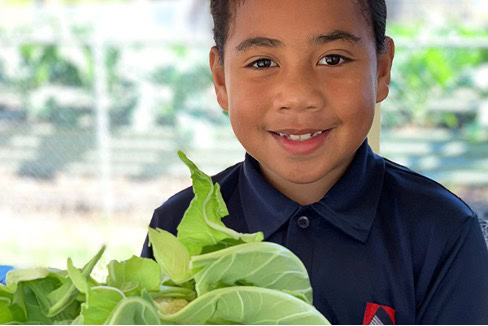
Parents and friends could also pre-order seasonal vegetables and place both orders and money into a specially provided, secure box. Students were responsible for collecting and checking these orders, tallying the produce amounts required, harvesting, weighing & bundling the vegetables, checking money, calculating change, and bagging orders. Daily garden-based activities were documented in an A1-sized journal, and sales were recorded digitally and graphed. This faith-based school follows the ancient principle of tithing, or ‘charitable’ giving, so 10% of sales were given to the on-campus church, and the remainder reinvested into the school garden to purchase items such as fencing, raised garden beds, and tools. Five community volunteers supported the programme with their expertise as well.
Key Insights:
Three of the smaller investigations embedded in the overall qualitative case study were:
1. The programme’s impact on the mathematical learning of children,
2. Its role and perceived benefits in developing financial literacies in students, and
3. How it impacted student perceptions of the actualisation of values.
Data collection took place during the spring term and involved engaging the Toronto Adventist School community through teacher interviews, volunteer focus groups, student focus groups, and parent focus groups. Observations and conversations with students during a school garden Open Day also took place, and information was recorded by students and teachers throughout the year in a garden journal.
Experiential in nature, school garden programs enable children to enact their values in practical ways. One insight to come out of the primary data was the overwhelmingly positive responses from students in the Grades 3-4 and 5-6 focus groups when asked whether their involvement in the school garden program has made them a better person. These children were able to articulate their answers using values as labels and gave examples demonstrating how their garden sessions helped to build their character.
A deeper understanding of financial concepts also emerged from students in later grades, including the concept of applying such knowledge in order to make informed judgements relating to the use and management of money.
Lastly, this programme provided opportunities for enriched mathematical learning facilitated by three features intentionally designed into the program:
1. Early exposure to mathematical concepts, skills, language, and tools through mixed-age groups experiencing mathematical learning in various contexts.
2. Application of mathematics in authentic, real-life settings provided students with positive experiences, which impacted their attitude toward mathematics, and
3. The consolidation of mathematical experiences through weekly engagement allowed students to reuse, reinforce, and practice their mathematics to improve their competence.
Impact and outcomes:
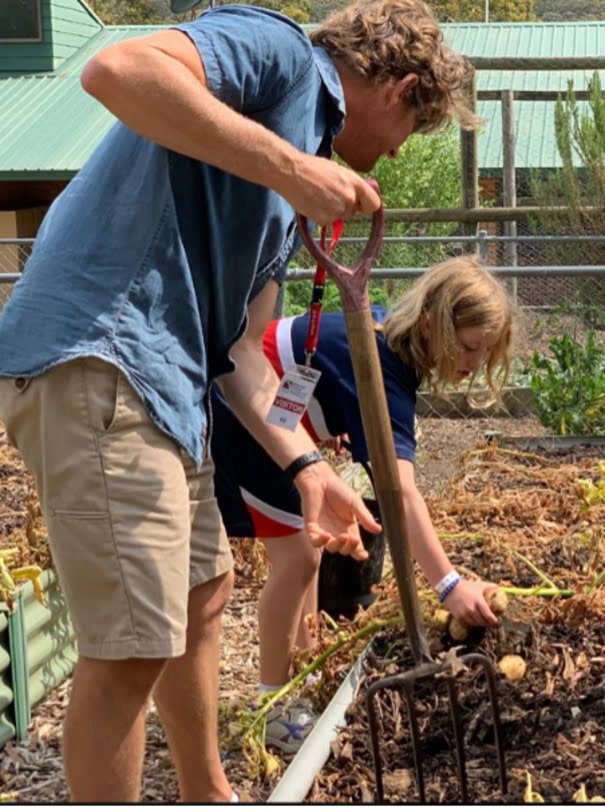
Dr Jason Morton working with children from the school helping to harvest potatoes from the raised garden beds. Photo Taken by Beverly Christian of Dr. Jason Morton and a Grade 2 Student. (Permission granted for child in photo for publication)
An Environmental Sustainability Grant application to Macquarie City Council on behalf of the school was submitted and used to purchase and implement raised garden beds, which transformed and improved the functionality and safety of the gardening program.
There was also a clear development in the children’s understanding of financial concepts as revealed in the responses of students from different age groups. The programme was also found to positively impact the mathematical readiness, attitudes, and competence of students, and through its organisational elements, the actualisation of their intrapersonal and interpersonal values as well.
Avondale University Researchers:
Dr Bev Christian
Dr Jason Morton
Dr Peter Williams
Sandra Ludlow
Dr Robyn Pearce
Dr Karyn Cameron
Andrea Thompson
Partners/Collaborators:
Toronto Adventist School
Macquarie City Council
Avondale Christian Education Research Centre
Research outputs:
Christian, B. J., Cameron, K. A., & Pearce, R. (2023). Growing capable kids: Exploring the nexus between Australian Curriculum's general capabilities, global competencies, and one school garden program. Journal of Outdoor and Environmental Education, 26(1), 127-146. https://doi.org/10.1007/s42322-022-00117-x
Christian, B. J., Ludlow, S., & Cameron, K. A. (2021). "In green pastures": The impact of one school's gardening program on children's perceptions of God and Jesus. In B. Christian, & P. Kilgour (Eds.), Revealing Jesus in the Learning Environment: Evidence and impact (pp. 59-82). Avondale Academic Press.
Christian, B. J., & Morton, J. (2022). Becoming better people: Children's perceptions of how a school's garden program has impacted their actualisation of values. TEACH Journal of Christian Education, 16(1), 27-34. https://doi.org/10.55254/1835-1492.1478
Williams, P., Morton, J. K., & Christian, B. J. (2022). Enhancing financial literacy in children 5–12 years old using authentic learning within a school market garden programme. Education 3-13, 50(3), 361-374. https://doi.org/10.1080/03004279.2020.1851741
Williams, P., Morton, J. K., & Christian, B. J. (2023). Mathematics from the ground up: an emerging model for enriching mathematical learning for children aged 4–12 using a school garden program, Education 3-13, 51(5), 740-753. https://doi.org/10.1080/03004279.2021.2007159
Funder(s) and amount:
Macquarie City Council: $2,178
Avondale Christian Education Research Centre Small Grant: $2,000
Fields of Research Codes:
3901 Curriculum and pedagogy
3902 Education policy, sociology and philosophy
Status:
Current (2019 - Now)
More information:
Sustainable Development Goals: