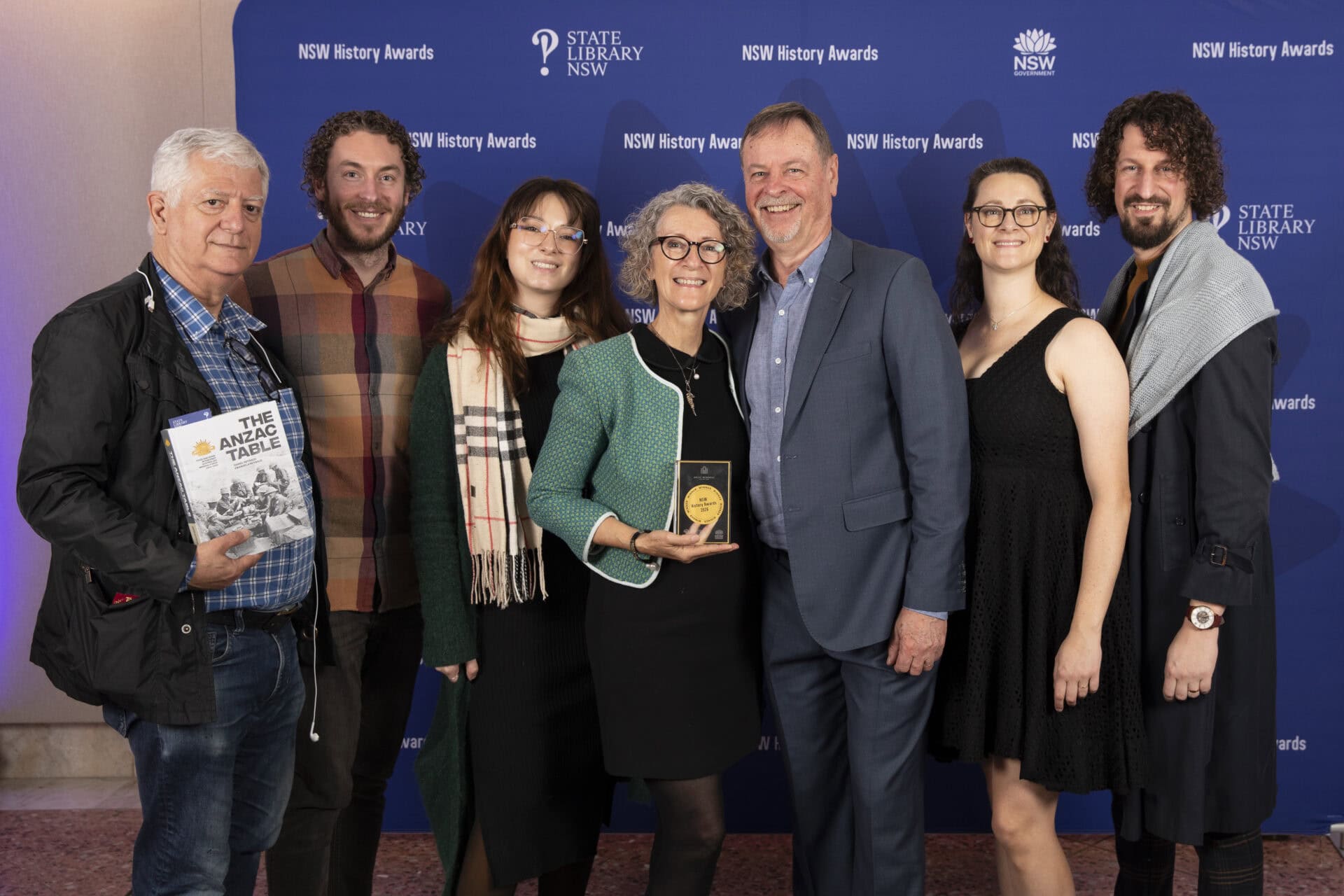
Emeritus Professor Daniel Reynaud and Emanuela "Emi" Reynaud have won the 2026 Anzac Memorial Trustees Military History Award for their book The Anzac Table, which explores the role food played in the lives of Australian and New Zealand soldiers during the First World War. The award, which forms part of the annual NSW History Awards, was announced during History Week at a ceremony at the State Library of NSW on Monday, 7 September.
Announcing the award, the judges said: "This book is an excellent single-volume treatment of a scarcely considered but critical facet of military campaigns, and opens the aperture ever further on our understanding of the AIF. Grounded in thorough archival research and richly illustrated, this well-structured and easily read book achieves the rare feat of being both authoritative and accessible to a wide readership. This book will be a valuable reference work on World War 1 for the historian, museum professional and interested reader."
The award, worth $10,000, is one of six categories in the NSW History Awards, administered by the State Library of NSW in association with Create NSW, with support from the History Council of NSW and the Anzac Memorial Building Trustees. This year's awards drew 208 entries, assessed by 14 judges, with a total prize pool of $85,000 across all categories.
The Anzac Table, published by Hardie Grant, is believed to be the first book to examine the food experiences of Anzac soldiers in depth, drawing on more than 1,200 diaries, letters and memoirs. It traces the origins of the "Anzac diet," unpicks popular myths and examines how food shaped soldiers' wellbeing, identity and sense of community under the pressures of war.
The book grew out of Daniel's earlier research into Anzac spirituality, during which he kept noticing a recurring theme in the soldiers' own writing. "There was no particular moment, just a growing awareness," he says. "Having worked with soldier diaries in the course of researching books on Anzac spirituality, I couldn't help noticing side themes. In particular, the soldiers often wrote about food. Being married to a foodie and hospitality professional, I quickly realised there was scope for a book, given the sheer volume of comments I'd already read." He and Emi went through those diaries and letters together, collecting the comments on food. "We were both surprised to find that soldier food was a topic that was virtually untouched by scholarship," Daniel says. "This was amazing, given how essential nutrition is to the fighting fitness of an army."
Emi wasn't so sure a book was on the cards at first. "As we started reading through the soldiers' memoirs, I thought we would be writing an article for one of the history journals about the way food was experienced in the AIF. I just didn't think there was enough for a book. I kept asking Daniel if he was convinced that there was a book in it," she says. "As we dug deeper, I realised how broad their food journey was and the depth of information on the topic of food. We ended up with a 350-page book. That's a pretty long article!"
The pair's different backgrounds shaped the finished book. Daniel brought his grounding in military history, having already read the diaries and letters of about 1,000 soldiers for his research into Anzac religion and spirituality. This previous research informed how The Anzac Table would be organised around recruiting, army camps, transport ships and life at the front. Emi, who ran her own catering business for years before moving into hospitality education in secondary schools, brought a practitioner's eye to the logistics of feeding an army. She traced the training syllabus used at army cooking schools and measured how inadequate it was in producing properly trained cooks. She also examined the limited, unvaried menus, poor nutrition, and inconsistent hygiene and safety standards that resulted. "Lucky the soldiers also bought extra food, ate with French civilians, stole fruit and vegetables from gardens and ate out in restaurants and cafes," she says. Daniel credits her expertise directly: "The book is much richer in its understanding of wartime food because of Emi's expertise in the area."
Both hope the book will change how people, and especially students, understand the Anzac legend. "As a high school teacher, I dream of our next generation being more informed on the harsh realities and the soldiers' stories, so honestly told, to enrich the knowledge of another area of the Anzac legend that has not been told otherwise," Emi says. Daniel, who has taught the world wars for two decades, sees the book as a corrective to popular ideas about wartime service. "Food is part of the Anzac legend, especially the myth that they lived on bully beef and Anzac biscuits. But both of these need serious qualification if we are to understand the real experience of the Anzacs," he says. "Demythologising is one of the aims of this book."
The Anzac Table took out the award ahead of two other shortlisted titles: Australia's Coastal War: When World War Two reached our shores by Tom Lewis, and New Feller Master: Beyond the Trenches Australia's Neglected WWI Story by Michael Piggott (both Big Sky Publishing).
Sources:
- [NSW History Awards 2026 winners announced | Books+Publishing](https://www.booksandpublishing.com.au/articles/2026/09/08/339833/nsw-history-awards-2026-winners-announced/)
- [The Anzac Memorial Trustees Military History Prize 2026](https://www.anzacmemorial.nsw.gov.au/event/anzac-memorial-trustees-military-history-prize-2026)
- [Shortlists announced for 2026 NSW History Awards | Australian Arts Review](https://artsreview.com.au/shortlists-announced-for-2026-nsw-history-awards/)
- [Anzac Memorial Trustees Military History Prize | State Library of New South Wales](https://www.sl.nsw.gov.au/awards/nsw-history-awards/anzac-memorial-trustees-military-history-prize)
- [The Anzac Table by Daniel Reynaud and Emanuela Reynaud - Avondale University](https://www.avondale.edu.au/news/heritage/the-anzac-table-by-daniel-reynaud-and-emanuela-reynaud/)
- Dr Lynnette Lounsbury


The most revealing thing about how organisations talk about sustainability is the word "initiative." An initiative is something you launch, resource for a while, congratulate yourself on, and quietly retire when priorities shift. It sits alongside other initiatives, competing for attention and budget. The moment sustainability is framed this way, as one project among many, an organisation has already told itself that this isn’t any more important than anything else. And it is. This is the planet we live on, the place our children will live when we leave – it isn’t trialling standup desks or a brand partnership.
For those of us in communications, this is not a peripheral concern. Communication is sometimes seen as the packaging around a strategy - but it is actually where the value of a strategy is decided and it's sincerity (or lack thereof) becomes exposed. So, the question I am posing here is one that crosses every business school discipline and every part of an organisation: how can we create long term value for people and make a profit that doesn’t cost the earth? And how do we embed sustainability rather than treating it as just another temporary initiative.
The honesty problem
Let me start with something that can be quite uncomfortable. Most of the anxiety around sustainability communication comes from an unspoken tension: the people writing these messages often privately believe things are getting worse, while the messages themselves are relentlessly upbeat. Emissions continue to rise. Biodiversity continues to collapse. The gap between what climate science demands and what economies are delivering is not narrowing and if we are honest when we talk about, the discussion can be bleak.
Pretending otherwise produces a particular kind of communication that audiences have learned to distrust, glossy, aspirational taglines and photos of wind turbines that have nothing to do with the organisation itself. Greenwashing is not usually a lie in the basic sense, it is more of a wild exaggeration of a small, good thing, communicated as though it were large.
The instinct in response is either cynicism or forced optimism. I want to argue for another way – honest constructiveness. People are complex enough to hold two things at once. Yes, the trajectory of planetary change is alarming, but yes, meaningful action is possible and worth doing well. Despair and denial are actually the same move; both are ways of choosing not to act. Communicating well means refusing that move on your audience's behalf.
Value, and who counts as a stakeholder
Here I want to be careful, because I am about to sneak in an idea that some people will find really natural and others will find quietly radical, so let me say it plainly rather than dress it up. The dominant framework in most business education treats the firm's obligations as running primarily to its shareholders, with everything else (workers, communities, the environment) as a constraint to be managed and minimised. The "triple bottom line" of people, profit, and planet was an attempt to widen that lens. But seriously – profit was still the real bottom line.
A more serious position, and one with a long intellectual lineage, is that value is created collectively and ought to be accounted for collectively. The worker who builds the product, the community that hosts the factory, the ecosystem that absorbs the waste, these are not externalities to the value equation. They are participants in it. When we speak of "long-term value for people, profit, and the planet," the interesting move is to stop ranking those three and start asking what it would mean to treat them as genuinely co-equal. We may even need to prioritise the planet if we want to keep living on it.
From initiative to identity
So, what does it look like when sustainability stops being an initiative? The shift is from something an organisation does to something an organisation is, and communication is how you can tell the difference.
An initiative generates announcements. An identity generates consistency. If sustainability is genuinely constitutive of an organisation, you see it even in all the boring places: in how procurement decisions are justified, in what gets measured in the quarterly review, in whether your bonus survives a decision that was good for the planet and merely acceptable for the quarter.
For communicators, this has a concrete and slightly deflating implication. The most important sustainability communication is internal, not external. It is the framing that shapes how a mid-level manager understands a trade-off at 4pm on a Tuesday. External communication that runs ahead of internal reality is precisely what audiences have been trained to detect and ignore. The credibility of the message to the outside world is downstream of whether the organisation actually believes it on the inside.
Here are a few principles worth holding onto:
Let’s go back to where we started for a minute, because I don't want to suggest you have to wallow in doom. The reason to be positive is not that things are fine. It is that hopelessness is self-defeating. The historical record is reasonably clear that large-scale change, when it comes, tends to arrive faster than expected. The relevant question for any organisation and communicator, is not whether the situation is dire, but whether you intend to be part of the response or part of the inertia. A communications discipline that can help organisations tell the truth about the stakes and remain capable of action is doing something genuinely valuable, in the fullest sense of that word.
References:
Centola, D., Becker, J., Brackbill, D., & Baronchelli, A. (2018). Experimental evidence for tipping points in social convention. Science, 360(6393), 1116–1119. https://doi.org/10.1126/science.aas8827
Global Carbon Project. (2025). Global carbon budget 2025. https://globalcarbonbudget.org/fossil-fuel-co2-emissions-hit-record-high-in-2025/
United Nations Environment Programme. (2025). Emissions gap report 2025: Off target — Continued collective inaction puts global temperature goal at risk. https://www.unep.org/resources/emissions-gap-report-2025
Way, R., Ives, M. C., Mealy, P., & Farmer, J. D. (2022). Empirically grounded technology forecasts and the energy transition. Joule, 6(9), 2057–2082. https://doi.org/10.1016/j.joule.2022.08.009
World Wide Fund for Nature. (2024). Living planet report 2024: A system in peril. WWF. https://livingplanet.panda.org/
Photo by Thirdman on Pexels
Spend enough time in leadership circles and you’ll hear the usual suspects: strategy, vision, execution. All important. But there’s a quieter force shaping whether any of those things succeed or fail, and that is - communication. Not just what leaders communicate, but how, when, and why they do it. Because here’s the uncomfortable truth: communication is never neutral. Every message a leader sends carries ethical weight. It signals values, distributes power, and shapes how people experience their work and each other.
Leadership Begins Before You Speak
Ethical communication doesn’t begin in the boardroom or the email draft. It begins internally with self-awareness. The best leaders understand that their internal world (their emotions, biases, assumptions) leaks into their external communication. Emotional intelligence, self-awareness, self-regulation, social awareness, and relationship management is not a “soft skill.” It’s the operating system of ethical leadership. Put simply: if you can’t manage your own reactions, you’ll struggle to communicate in ways that build trust. Or, as we might put it more bluntly: you can’t lead others if you haven’t learned to lead yourself.
The Hidden Power in Every Message
Once communication enters an organisation, it enters a system of power. A casual comment from a colleague is just that. The same comment from a leader? It becomes direction, pressure, or even threat, whether intended or not. This is where ethical leadership becomes less about intention and more about impact.
A short email saying, “We’ll be monitoring performance more closely next month,” might seem efficient. But depending on context, it may be heard as: We don’t trust you. Ethical communicators anticipate this gap between what is said and what is heard and close it. They don’t just ask, “Is this clear?” They ask, “How will this be experienced?”
Trust Is Built One Message at a Time
Trust isn’t built through grand speeches or carefully worded values statements on a website. It’s built through patterns; small, repeated acts of communication that either align with values or quietly contradict them. Say you value wellbeing, but dismiss concerns about workload? The message isn’t unclear; it’s just inconsistent. And inconsistency is where trust goes to die. Ethical leadership communication, then, is about ensuring that what you say, what you do, and what people experience, all point in the same direction.
Ethics, Empathy, and the Human Factor
At its core, ethical communication is relational. It requires leaders to consider the people on the receiving end of a message not as abstract “stakeholders,” but as humans navigating pressure, uncertainty, and context. Empathy doesn’t mean avoiding hard conversations. It means delivering them in ways that preserve dignity and invite understanding. When ethics and empathy work together, communication becomes something more than information transfer. It becomes a tool for building psychological safety, shared purpose, and genuine connection.
A Quick Word on AI (Because It’s 2026)
We can’t talk about communication today without mentioning AI. Yes, AI can help draft emails, summarise reports, and even suggest tone. I mean – I used Ai to summarise five thousand words in lecture notes so I could pull out the main points for this article. It can save an incredible amount of time for busy people. But ethical leadership requires that responsibility doesn’t get outsourced along with the first draft. Leaders remain accountable for every message sent under their name, so there needs to be some guidelines in place around using AI ethically as a leader. These can be quite simple:
If the answer is no, no amount of algorithmic polish will fix it.
So, What Does Ethical Communication Look Like?
It looks like clarity without manipulation. Empathy without avoidance. Authority without coercion. It looks like leaders who understand that communication doesn’t just describe reality, it helps create it. And perhaps most importantly, it looks like leaders who recognise that every message is an opportunity to build trust and to include people. The difference, as it turns out, is not in how much you say, but in how responsibly you say it.
Image by Matheus Bertelli on Pexels
Associate Professor Seedwell Sithole brings a rare combination of academic rigour, global research perspective, and deeply values-driven leadership to his role as Course Convenor for the Bachelor of Business at Avondale University. At the heart of his work is a simple but powerful question: What kind of graduate does the world actually need now?
Seedwell is a teacher, but he is also a passionate researcher. His recent publications reflect a scholar actively engaging with the changing landscape of higher education and professional business practice. In The International Journal of Management Education (2025), he explores how social responsibility can shape quality assurance in accounting education, arguing that universities must move beyond compliance and towards cultivating ethical, reflective practitioners. In another 2025 study in the Journal of International Education in Business, he examines how self-efficacy in accounting students is formed, including the role gender plays in shaping confidence and learning outcomes. Meanwhile, his bibliometric work in the European Scientific Journal offers timely insight into how generative AI is reshaping academic publishing in accounting.
He closely connects this research to the classroom, with current projects directly informing the future direction of business education at Avondale. These include investigations into whether accounting graduates are equipped for the startup economy, the employability of international graduates in regional Australia, and how diverse research paradigms shape accounting education itself. Alongside colleagues, he is also exploring how Christian faith influences financial decision-making, bringing a distinctive ethical lens to business practice.
Yet what grounds Seedwell’s work is not only his scholarship, but his life beyond the university. He speaks often about the importance of intentional living, being present, making deliberate choices, and focusing on what truly matters rather than simply staying busy. This perspective has been shaped not only by his reading, but by everyday life: conversations with his wife, and the evolving relationships with his three children as they grow into independence.
Family is central. Whether it’s evening check-ins, once around the table (now often virtual as his children move into new stages of life), or one-on-one walks that open space for deeper conversations about ambition, purpose, and identity, these moments form the quiet architecture of his values. Recently, even something as simple as a shared step-count challenge on an app called Step Up has become a source of connection, expanding to include extended family and turning daily movement into a shared rhythm of encouragement and fun.
This grounding in family life flows directly into his philosophy of education. His emphasis on preparing graduates who are not only technically competent but adaptable, ethically grounded, and purpose-driven mirrors the same intentionality he strives for at home. Even his interest in travel, now often expressed through reading, documentaries, and the anticipation of future journeys, reflects a curiosity about people, cultures, and the broader human story that shapes his teaching.
Across all of this work runs a consistent thread: preparing graduates who are ready to lead in complex, real-world environments without losing sight of what matters most. His vision for the Bachelor of Business is clear: a degree that connects deeply with industry, reflects the values of the Adventist tradition, and equips graduates to thrive, whether in corporate roles, entrepreneurial ventures, or community leadership. Associate Professor Sithole’s goal is not simply to educate students, but to shape a generation of thoughtful, purposeful leaders - people who, like him, understand that how we live matters just as much as what we achieve.
For Dr Aleta King, the release of Handing on the Baton: The Conductor as Musicianship Mentor is not simply the publication of a book, it’s the closing of one chapter and the quiet beginning of another.
“It’s a strange feeling,” she reflects. “Relief, mostly. And satisfaction. When you write something like a doctoral thesis, it takes all of your heart and soul.”
Originally developed as her doctoral research, the book explores King’s Conductor as Musicianship Mentor (CMM) model, an approach that repositions the conductor not just as a musical leader, but as an educator shaping the musicianship of every performer in the room. Grounded in real rehearsal and performance contexts, the model is tested through three major works: Bach’s Cantata BWV182, Fauré’s Requiem, and Jenkins’ The Armed Man.
But what sets King’s work apart is not just its academic rigour, it’s its lived reality. “This wasn’t theory for theory’s sake,” she says. “It grew out of the rehearsal room. Out of working with real musicians, solving real problems, and thinking deeply about what it means to lead musically.” That intersection, between conducting, teaching, and mentoring, sits at the heart of the book. It’s a space King believes has often been overlooked. “There’s a tendency to separate performance from pedagogy,” she explains. “But in practice, they’re inseparable. Every rehearsal is a teaching moment. Every gesture, every decision, it shapes how musicians think, listen, and perform.”
The journey to publication, however, was not immediate. After completing her thesis, King deliberately stepped away from it. “I needed distance,” she admits. “When you’ve poured that much of yourself into something, you need time before you can come back to it with fresh eyes.” Returning to the work through the publishing process brought an unexpected surprise. “I actually enjoyed reading it again,” she says, smiling. “That was a really nice moment, realising that the ideas still resonated, that they still felt meaningful.”
One of the most personal elements of the book is its cover image: a photograph of a medieval Guidonian Hand, sourced from a 14th-century manuscript held in Oxford’s Bodleian Library. King travelled to England to capture it herself, spending a brief two-hour window examining the rare text. “That was special,” she says. “It felt like a connection to a long lineage of musical teaching and learning.”
Now in print, the book represents what King describes as a “small but significant contribution” to the field. Aleta also wants it to be known that she had a strong support system around her as she wrote this book. “I couldn’t have done this without the people around me, my supervisors, mentors, colleagues, friends, family. It’s never a solo achievement.”
At Avondale, where she serves as Director of Music, the ideas in the book continue to play out daily in her work with students. “Ultimately, they’re the legacy,” she says. “If this research changes the way they think about music-making, if it helps them become more thoughtful, more responsive musicians, then that’s what matters.”
As for what comes next, King is ready to turn her attention in a new direction. “I feel like I’ve drawn a line under this particular area of research,” she says. “But the principles will stay with me. They’ll keep shaping how I teach, how I conduct.”Her next ambition is something more personal: composing and arranging. “That’s the dream,” she says. “To spend more time creating music, not just interpreting it. Watch this space!” For now, though, Handing on the Baton stands as both culmination and a gift, a work that captures years of thinking, making, and mentoring, and offers it forward to the next generation of musicians.
There’s a reason some brands and leaders can say one sentence and suddenly a market moves, a board shifts, a partner says yes, or an audience leans in. Persuasive communication isn’t about volume, dominance, or dumping facts on your stakeholders. It’s about meaning, emotion, simplicity and timing.
The best persuasive communicators in business today do 3 things exceptionally well:
When this aligns, persuasion becomes effortless. Not manipulative. Not aggressive. But elegant, strategic, high trust influence. Here are examples of some brands doing this really well.
Patagonia: The moral authority effect
Patagonia doesn’t just persuade through brand storytelling; they persuade through principled stance. When Patagonia ran that infamous Black Friday ad “Don’t Buy This Jacket” it didn’t make people buy less, it made people trust them more. And trust is the most efficient persuasion technology on earth. Their communication works because it is values-led, not persuasion-led. Ironically that’s what makes it even more persuasive, but the persuasion isn’t turning someone into an instant customer, it is turning them into an ally for life. People know that Patagonia will give them an excellent product but will also repair it and recycle it when they are done. They practice what they preach.
Airbnb: Sell the belonging not the bed.
Airbnb does not sell rooms. They sell the feeling of belonging anywhere. That idea is so sticky it became a global movement. Their brand narrative strategy is intentionally persuasive — because it reframes the value. Most hotel companies market “features”. Airbnb markets “identity” and uses phrases like “the world beyond your bucket list” and “don’t see a place, experience it.” Identity is always more persuasive than functionality and Airbnb understands this.
Liquid Death: Ridiculous clarity wins attention
Liquid Death’s brand is theatre. They take water, one of the world’s most boring commodities, and turn it into a metal band satire that “murders your thirst”. They persuade by breaking patterns and being extremely clear about what they are (and what they’re not). It proves that if everyone is trying to sound serious, the funniest person in the room becomes the most persuasive, as long as the brand promise still holds weight.
So, what does this mean for your business? The art of persuasive communication is not mysterious. It is built by design. Business leaders who communicate persuasively do not talk at people. They architect engagement with people. This is where persuasion becomes the twin of leadership, because leadership isn’t about coercion, it’s about creating gravitational pull.
5 Things Every Business Should Consider for Persuasive Communication Best Practice:
Persuasive communication isn’t magic, it is a learnable craft and the more you intentionally practice it, the more naturally your ideas will spread and stick.
Image by Drazen Zigic
If you’ve ever played a game where no one explained the rules, you’ll know how quickly confusion turns into frustration. The same is true in business. Employees can’t deliver what leaders want if the expectations are murky. “Do your best” sounds inspiring, but it’s vague. “Submit the client proposal by Thursday at noon, using the updated template,” is a whole different story.
Here’s a simple example. A manager asks their assistant to “book a table for lunch with a potential investor.” They mean at a quiet bistro near the office. The assistant assumes they want to impress, so books the hottest new spot in town, complete with loud music and a 45-minute wait. Unsurprisingly the deal doesn’t exactly get off to a smooth start. Moral of the story? Precision saves both embarrassment and opportunity and clarity always beats assumptions.
Think of expectations like setting a GPS. If you tell someone, “Head north,” they might end up in Darwin. If you plug in the exact address, they’ll get to your office on time. Ambiguity is the enemy of accountability. When people don’t know exactly what’s expected, they default to their own interpretation, and that rarely matches yours.
How bad can a mere miscommunication really be though? Well, Boeing is a prime example of how it can cost billions and worse, human lives. Boeing was the global leader in commercial aircraft for decades. But in the mid-2010s, Airbus unveiled the fuel-efficient A320neo, winning massive orders. Boeing rushed to respond with an upgraded version of its 737: the 737 MAX. The goal was to get the plane to market quickly. What they failed to do was communicate the change to their pilots. Boeing engineers added a software system called MCAS (Manoeuvring Characteristics Augmentation System) and as they considered it a minor adjustment, they didn’t want to burden the airline or pilots with new training sessions. Some were told it was a simple change; some were not even told it existed. Each team thought it was handling the communication responsibly, but critical details fell through the cracks.
In 2018 and 2019, two 737 MAX planes (Lion Air Flight 610 and Ethiopian Airlines Flight 302) crashed, killing 346 people. Investigations revealed that pilots were fighting a system they didn’t fully understand, with little training or documentation to guide them. It devasted thousands of families, ruined Boeing’s stellar reputation and cost them billions. This wasn’t a technical flaw; it was a communication failure at scale. The tragedy shows that miscommunication isn’t always about someone saying the wrong thing. Often it is simply about what is not said, or what it is assumed that everyone already knows.
Communicating expectations is not about micromanaging. It’s about drawing the map, so your team knows the destination and the boundaries of the road. Once they’re clear on that, you can step aside and let them drive.
Practical Advice: How to Communicate Expectations Clearly
Further Reading:
If you want to go deeper, try the book Radical Candor by Kim Scott. It’s a fantastic book on how to balance clarity with care, giving feedback and setting expectations in a way that empowers rather than alienates your team.
Image by pvproductions via FreePic
For Associate Professor Dr. Seedwell Sithole, the path into academia began with a simple but persistent question: why do some businesses thrive while others struggle? Growing up, he noticed how financial management could determine the fate of small enterprises in his community—and, by extension, the wellbeing of families and neighbourhoods. That early fascination drew him into accounting practice, first with Delta Corporation in the retail sector, then in commercial banking, and later with Christian Care, managing resources for projects improving water, sanitation, and nutrition in disadvantaged communities. Yet his focus was never just on numbers. As he reflects: “Over time, I found myself increasingly drawn to questions about how accounting could be taught more effectively and meaningfully. That curiosity led me to pursue a PhD in Accounting at the University of Wollongong, focusing on cognitive load theory and its application in accounting education. From there, I knew my calling lay in teaching, mentoring, and research helping students navigate complex information and preparing them for meaningful careers in business.”
These professional and academic experiences revealed both the technical and ethical dimensions of accounting, and they planted a deeper curiosity: how could financial knowledge be taught in ways that empower people, shape better decisions, and foster integrity? This question continues to drive his work at Avondale.
Today, his research sits at the intersection of accounting education, ethics, and curriculum design. “The big question for me,” he reflects, “is how we can prepare graduates who are not only technically competent, but also ethically grounded and socially responsible.” It is a question that continues to drive both his classroom practice and his scholarly collaborations.
Current projects highlight the depth and reach of that vision. At Avondale, he is leading a research grant on Christian faith and financial decision-making, exploring how values shape choices in business and personal finance. Internationally, he is collaborating with colleagues at Universitas Advent Indonesia on a proposal addressing equitable energy transitions—research with global implications for sustainability and justice. His recent publication in The International Journal of Management Education further reflects this commitment, examining how social responsibility informs quality assurance in accounting education. His next venture is the presentation of a paper at the 2025 Accounting Educators Conference.
The impact of Dr. Sithole’s research extends beyond the academy. His evidence-based teaching resources have improved student outcomes, while his partnerships with CPA Australia and industry employers ensure graduates are work-ready and values-driven. “It’s about linking technical skills with ethical awareness,” he says. “That’s what makes education transformative.” What grounds his work is a strong sense of community—both at Avondale and beyond. He describes the School of Arts and Business as a collegial environment where collaboration, innovation, and mentorship thrive. Outside the university, he finds inspiration through family, faith, and travel, experiences that continually refresh his perspective on leadership, sustainability, and service. In many ways, Dr. Sithole’s story exemplifies the mission of Avondale University: scholarship that is rigorous, globally connected, and deeply human. His research does not simply ask how businesses succeed, but how they—and their graduates—can contribute to a more ethical and sustainable world.
In today’s volatile environment, businesses, whether small or multinational, are vulnerable to a range of crises: anything from supply chain failure, to social backlash or even cyberattack. How you communicate during these events can shape customer trust, stakeholder confidence, and long-term survival. Crisis communication is not just about damage control. It’s about preserving your reputation and demonstrating leadership under pressure. The traditional model of crisis communication was developed by W.Timothy Coombs and is called Situational Crisis Communication Theory (SCCT) and it identifies three main responses which will depend on your level of responsibility as a business. It offers an ethical roadmap based not only on reputational risk but also moral responsibility.
From an ethical perspective, transparency and empathy must guide your choice of strategy. Anything less risks long-term reputational damage and public distrust. A recent example of a company who did crisis communication really well was Owala, a popular drinkware company, who in 2024 voluntarily recalled nearly 2 million water bottles due to a choking hazard posed by a faulty spout design. While a recall could be disastrous for a brand built on health and safety, Owala’s textbook-perfect communication strategy turned the crisis into an opportunity to deepen customer trust. Here’s what they did well:
As a result, the brand experienced only a minor dip in reputation, followed by a spike in customer loyalty and online praise for “doing the right thing.” Another great example is the Australian B-Corp “profit for purpose” toilet paper company Who Gives a Crap who, during the height of COVID-19 panic buying, faced massive demand they couldn’t meet. Instead of hiding behind logistics excuses, they embraced full transparency. They turned ethical communication into loyalty by using:
This approach wasn’t just good PR — it was a values-driven response that aligned with their brand purpose and respected their customers. Using Coombs model, but also tried and true methods from companies who have had to face similar issues, here are five ethically grounded tips for any business facing a crisis:
So, what happens if you do it another way? Unethical crisis communication happens all the time. It almost always backfires and ends up with deep reputational damage. For example, in 2015, Volkswagen was caught cheating emissions tests with illegal software in millions of diesel cars. Instead of taking immediate responsibility, the company blamed rogue engineers and delayed a full apology. Their inconsistent and technical messaging ignored the environmental harm and public trust issues. The fallout included over €30 billion in fines, global reputational damage, and ongoing legal trials. It’s a stark reminder: in a crisis, ethical and transparent communication is both your survival as a company, and the right thing to do.
You can’t always prevent a crisis — but you can plan for it. Smart communication can be the difference between a stumble and a catastrophe. As Coombs reminds us, “The perception of responsibility matters just as much as the reality.” Crisis communication is your moment of truth. It reveals your business’s character — to your customers, your staff, and your community. The question isn’t just how you’ll respond, but who you’ll be when it matters most.
Image via Freepik from wirestock