Aussies and Kiwis typically don’t like people who brag and self promote. However, recent research reported in INSEAD Knowledge online [CLICK HERE TO READ] and involving about 2,600 participants in the United States, United Kingdom, and Singapore suggests there are times when bragging could be a positive thing. Given how reserved the UK and Singaporean participants would typically be the results may will hold true for Australia and New Zealand.
The research found that talking about your accomplishments at work can have different effects depending on whether you're the boss or a colleague. When bosses share their successes, it often motivates their team to work harder. This is because employees see their bosses as role models who have earned their success, and they view it as a guide for their own success.
However, when coworkers boast about their achievements, it can be annoying and make others feel insecure. People wonder why they haven't achieved the same success and may feel threatened. The research also found that when coworkers bragged in a way similar to bosses, it didn't inspire others. Instead, it made them seem arrogant.
The key to effective self-promotion is having a respected role model share achievements that others can realistically aim for. The person's status and how relevant the success is to others' work play a big role. Success should be linked to things people can control, like hard work, rather than things beyond their control. The study didn't find any big differences based on gender or race.
In simple terms, if you're a leader, sharing your positive achievements with your team can motivate them. But it's important to talk about things that your team can actually achieve, and not to brag too much. This might encourage your team to go after their own goals.

"Move Fast and Fix Things," authored by Frances Frei and Anne Morriss and published in 2023 by Harvard Business Review Press, is a transformative guide that extends beyond the boundaries of conventional organizational change literature. While ostensibly focused on organizational change, the book offers a set of principles with broad applicability, presenting an optimistic perspective on achieving goals.
Diverging from established organizational change models, the book introduces an empowering leadership approach aimed at expediting effective problem-solving. Notably, it doesn't position itself in opposition to existing models but complements them, providing a fresh perspective rooted in practical experience and real-world examples. Central to its philosophy is the cultivation of trust within organizations, crucial for garnering stakeholder support and achieving swift results.
The authors articulate a unique framework, leveraging the days of the week as a step-by-step process:
This structure, using the days of the week, adds a practical and actionable dimension to the book, making it accessible and easy to follow. The authors advocate for a proactive and efficient approach to addressing challenges, emphasizing the importance of trust-building, relationship-building, and effective storytelling in the process.
The book stands out for its readability, offering clear and concise guidance. The practical steps provided offer a refreshing new perspective on tackling substantial issues within organizations. Personally finding it highly beneficial, I intend to include it in my recommended readings for change management. "Move Fast and Fix Things" serves as a valuable resource for leaders seeking innovative approaches to navigating the complexities of organizational change.

“How do you prepare a workforce for the future when you don’t know what the future will bring?” Author Pia Lauritzen poses this question in a recent online article in Strategy+Business [READ IT HERE]. Right from the outset Lauritsen answers the question by proposing it is by enabling your people to adapt to change, and to show them how to be prepared for anything.
Using a real-life case study from 2022 of the Audi paint shop, the article highlights the use of questions to understand how best to prepare the team for change. The questions used “revolves around understanding and embracing the five levels or shades of uncertainty on the journey towards transformation: wonder, scepticism, curiosity, doubt, and creativity.” Specifically, the five stages looked like the following:
Within the article are some powerful examples of how these were used with great effect. Some of the discoveries during the process included:
Quoting one of the leadership team, the article notes a very important learning from the experience, “But to make a sustainable and profound change and to create an environment where something can grow and have a long life, you must talk about the topics that are relevant to the people.” Seemingly so obvious, yet so frequently missed.
To summarise the learnings of the case study as a whole, the major outcome from using this powerful questioning process is to recognise the keys to preparing an organisation for anything is time, transparency, and trust.

We cannot escape AI, and more often than not, we don’t even realize we have been interacting with it. For all you know, this could be AI instead of the real me! And there are some societal issues that we need to be aware of in relation to the use of AI. A recent online article from KelloggInsight [READ IT HERE] calls out two very specific issues that could counteract the benefits of AI.
The article delves into the paradox of generative AI, exemplified by tools like ChatGPT, which promise increased individual efficiency but may raise societal red flags. Sébastien Martin, a Kellogg assistant professor, points out the inherent conundrum: to harness the efficiency of generative AI, individuals must sacrifice fidelity, i.e., how closely the output mirrors their unique style. For individuals, the choice is binary: settle for AI-generated content as "good enough" or invest extra time in customization. However, the article scrutinizes the broader societal repercussions of this dilemma. Research by Martin, Francisco Castro, and Jian Gao of UCLA suggests that widespread generative AI use could breed content homogeneity and amplify biases from the AI's training data throughout society.
Employing a mathematical model, the study unveils a bleak trajectory where AI-generated content becomes progressively more homogeneous than user-generated content, leading to a "homogenization death spiral." As AI-generated content trains the next AI generation, uniformity compounds, exacerbating the issue. The model also hints at biases ingrained during AI training evolving into pervasive societal biases.
Despite these challenges, the article offers potential remedies. Interactive AI tools encouraging user input and manual edits could counteract adverse effects. Allowing users to express preferences and edit AI-generated content might prevent excessive homogeneity and bias. This user-involved approach may entail the AI asking users clarifying questions or presenting multiple contrasting outputs for user selection. While these solutions might momentarily impede the user experience, the article contends they are indispensable for the sustained viability of generative AI. By actively engaging users in shaping content, these measures aim to uphold diversity and mitigate the risk of biased outputs influencing society.
Martin remains hopeful about generative AI's potential in content creation, especially if it continues to encapsulate the full spectrum of human preferences. He acknowledges AI's capacity to draw more individuals into creative pursuits, enriching diversity. However, the article underscores the imperative of responsible development and usage of generative AI, ensuring it benefits individuals and society without compromising diversity, personalization, or succumbing to potential biases.
So, it’s not a case of IF you use AI, but rather HOW you use it. Remember that investing the time to train it and help to build a better AI for us all. In case you were wondering, I wrote the first and last paragraphs of this article, but I let AI write the rest. Could you tell?

December always sneaks up on me (as does the need to Christmas shop!). I do enjoy the month of December, as it is a wonderful opportunity to both review the year that was, and look forward to the year ahead. The lessons we can learn, the goals we set for our future, and the growth we experience through taking on new challenges are all part of this year-end review that I relish.
As we plan professionally for 2024, it is important to understand what challenges are likely to face our organisations in the year ahead. This article by HRM Online unpacks recent research on what challenges HR can expect in 2024. The challenges noted are much of the same, but especially highlight the challenges of AI, hybrid work, and ongoing recruitment difficulties.
The five top predicted trends for 2024 in the HR space are:
What will really set organisations apart is not too different from previous years, but is their strategic decision making around their people and technology integration. Happy planning for 2024!
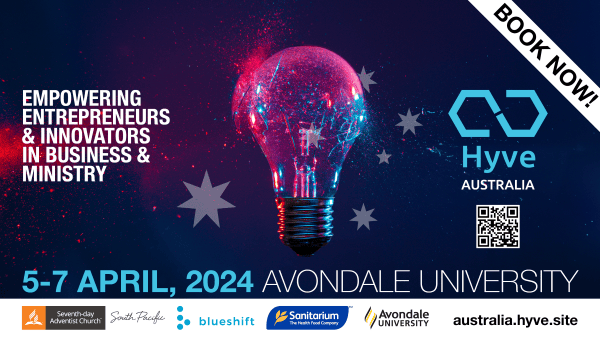
Avondale is proud to be partnering with a number of Chrisian enterprises to being you Hyve Australia 2024. Building on the initial Hyve held earlier in 2023 (Click here to watch a short report of Hyve 2023), the call is out to all business professionals, entrepreneurs, and innovators to register for another weekend of empowering in business and ministry, April 5- 7, 2024 at Avondale University. .
In today’s challenging economic environment more people than ever, especially young adults, are creating start-up businesses and getting income from entrepreneurial ‘side hustles’. Have you got a great idea, a prototype or a burning desire to start something? Or do you already have a professional career or business and are ready to scale it up or make it more missional? Based on the success of the 2023 event, Hyve Australia 2024 will provide opportunities to network with other visionaries, entrepreneurs, missional CEOs, investors and innovators who are seeking to have a ‘mission refocus’ in their life story.
Watch a short video on Hyve Australia 2024 by CLICKING HERE
See you there!
Learn more at australia.hyve.site
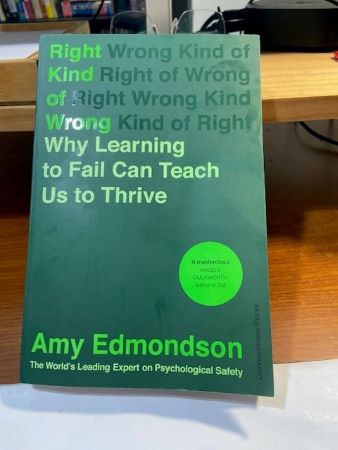
Is there a right way to fail? And a right kind of wrong? Amy Edmonson certainly believes so and makes her case in her recently released book Right kind of wrong: Why learning to fail can teach us to thrive (2023, Cornerstone Press). Amy Edmonson, a professor at Harvard Business School and the world’s leading expert on psychological safety, believes that her book “offers a typology of failure that helps you sort out the “right kind of wrong” form the failures that you should work hard to precents, and that you will learn how to think differently about yourself and failure, recognize contexts in which failures are likely, and understand the role of systems.
All of the points made throughout the book are supported not only with science, but illustrated with stories and case studies that bring the concepts alive. Another thing going for this book is that Edmunson honestly admits that her ideas are easy but addresses the hurdles one might encounter. While parts of this may not be easy, the consequences are very worthwhile.
The first prat of the book explores the three types of failure – intelligent, basic, and complex, and puts them into context with some high-level tools for dealing with them. The second part of the book delves “deeper into tactics and habits that allow people to practice the science of failing well at work and in their lives.”
I really appreciated the positive tone that the book ends with, captured in the title of the final chapter ‘Thriving as a fallible human being’. It is a realistic yet optimistic way to finish this excellent book.

I’ve recently noticed an increase in the number of colleagues expressing feelings of exhaustion and burnout. Apparently, it is much more common that I thought. A June 2023 report by Deloitte Insights [READ IT HERE] finds that most employees are struggling. Based on a survey of 2150 people across the US, UK, Canada, and Australia, they found that only around one-third of employees felt their health improved on the last year, whereas “three out of four executives inaccurately believe that their workforce’s well-being improved, illustrating that leaders didn’t have a firm grip on how their teams are really doing.”
Other findings of note in the report include:
Thankfully the report also provides a pathway forward, but with the caveat it needs to be a long-term view. The three keys to unlocking workforce well-being are:
The report concludes with a challenge to organisations to acknowledge how exhausted and stressed workers are, to empower and resource managers to provide support, and to take the broader perspective of not just their own organisation, but to also consider societal well-being. How well does you organisation manage worker well-being? How do you know?

It is no surprise to us to hear the workplace has changed, especially given the rate of technological innovation being introduced and that we are still yet to face. Many of us are still trying to make sense of it all. A recent online article from Deloitte Insights (READ IT HERE) addresses one of these challenges – how to know it is making a difference. The article notes that with all the newly introduced technologies, productivity is actually declining! Consequently, they propose that its time to find a different (better) metric to measure what matters. They illustrate this by pointing out that “traditional productivity math tends to focus on reducing input and increasing output, but more output may not necessarily translate to better (or more efficient) results.”
One of the issues with traditional productivity tracking is that it can lead to what the article refers to as “performative work.” That is, it is where employees engage in activity that gives the appearance of productivity. Quoting from a survey conducted by Slack, it was found that an average employee spends 32% of their time on such activities. Another issue with traditional productivity metrics is that they may actually exclude segments of the workforce, like contractors and service providers, which does not paint a true picture of productivity. And the new skills required in the workplace do not feature in traditional productivity measures. Skills like problem-solving are not easily measured.
Having highlighted some of the issues with traditional productivity measures, the authors do provide some ideas for an alternative. Instead of focussing on activity, the focus should be on “whether the work being done is the right work.” This involves a shift in focus “from productivity to performance, from productivity outputs to human outcomes.” Business outcomes are relatively easy to conceive and measure, and can include value, quality, customer retention, etc. But the human outcomes are more difficult. These may include “the goals and objectives that help an organisation’s people thrive physically, emotionally, financially, and professionally.” The article refers to a survey that reports people “prefer to be evaluated on their performance – what they produce or achieve, the quality and impact of their work, and their personal growth and skills development.” An example offered in the article is to measure worker happiness, which has been “linked to improved engagement, productivity, and culture, and reduces attrition risks at the enterprise level.”
The last word on this belongs to the authors; “quantitative productivity metrics may still have a specific role to play in the workplace, but more meaningful measurements should be considered when it comes to evaluation and prioritizing how we perform as humans. Organisations who can untether themselves from the productivity metrics of the last century could discover new opportunities to measure what matter and create a more inclusive, human-centered future.”
A recent article by Yves Doz and Keeley Wilson, published online in INSEAD (READ IT HERE) advocates strongly for strengthening the link between strategy-making and governance. They note that boards are often comprised of directors with skills, knowledge, and experience, but who frequently lack a strategic mindset. But when such leaders develop “strategic minds, they can serve as effective guardians of a company’s future framing purpose, setting strategic direction, and stimulating ambitious strategic intent.”
Drawing on both research and experience, the authors note eight key traits they believe underpin a strategic mind:
Taking steps to intentionally develop a strategic mindset means “directors can become effective custodians of a company’s future and drivers of its strategic direction.”