While managers manage and boards govern, the board does retain ultimate responsibility for the organisation and its performance. Most recently this includes responsibility for the role of generative AI in the organization, noting that generative AI is developing at lighting speed and is being rapidly adopted across all industries.
A recent McKinsey & Company online article (CLICK HERE TO READ) provides some much needed guidance for boards on generative AI and their organisation. Boards run the risk of being too slow to adopt and being left behind or integrating too quickly and getting things wrong. The article poses four questions the board can ask of management to help them weigh the risks and benefits. Each question (listed below) is followed by some excellent notes on what this means for the board, and what follow up it might involve.
In addition to these questions for management, the board should also ask some questions of themselves:
Whilst not exhaustive, these questions provide a platform for boards to better understand and evaluate the integration of generative AI into the organisation.
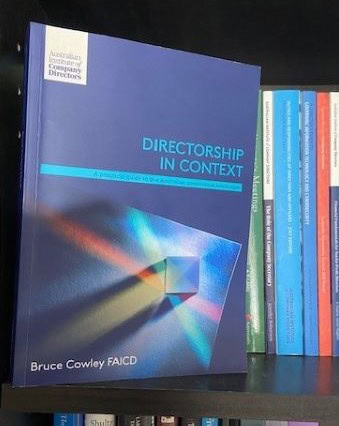
I love all things governance and keep a keen eye out for any new resources that actually add something new to the field, and don’t just repackage existing ideas. Once such resources just published is Bruce Cowley’s new book ‘Directorship in Context’ (2013, AICD), which contributes significantly to helping directors grapple with the latest issues.
Rather than just follow the established format of the various statutory directors’ duties, this book is about putting these into the context of actually governing organisations. In easy-to-follow style, Cowley expands on and illustrates the obligations of boards and directors on the latest legal issues and cases (e.g., wage theft, modern slavery, cyber-security, etc). But the book brings so much more by also addressing stakeholder interest, community expectations, ethics, and organisational culture, again, with reference to the latest legislation, legal cases, royal commissions, and more.
This is an excellent resource for every director, especially those with a foundational understanding who want to broaden this and take their directorship to the next level. Highly recommended.
Click on this link to see more about this book.

I find delight in every season, but there is something particularly glorious about the spring and summer months. It usually also means a holiday is coming! A most wonderful opportunity to switch off from work, enjoy time with loved ones, perhaps see a new place, and find joy in whatever form that looks like for you.
That’s all great, but we all know that familiar feeling of returning to work and within a couple of weeks we are ready for the next break! So how do we approach vacations from work, to ensure we get the most out of our breaks and sustain the restorative benefits they bring? I happened upon a couple of podcasts recently that I found really helpful:
There has been plenty of discussion on the importance of taking breaks from work, and the benefits they bring in terms of improved physical and mental health, as well as improved productivity, creativity and resilience at work. How long do these benefits last? Dr De Bloom’s research suggests that within 1-2 weeks of returning to work, we are right back to our pre-holiday state. One suggestion for lengthening vacation effect is to return to work on a Wednesday and have a shorter first week back, rather than jumping straight back into long hours. The research also generally supports the notion that taking shorter breaks more regularly is more beneficial than taking longer, less frequent breaks.
Then there is the question of what type of vacation is the most restorative: home or away, active or quiet, planned or spontaneous. The answer is whatever you find joy in. Adam Grant talks with Dr Sabine Sonnentag in his podcast, discussing two different kinds of recovery activities that Dr Sonnentag identified through her research: relaxation and mastery experiences.
Relaxation is the slower paced activity we think of when we picture ‘unwinding’, perhaps by reading a book or watching a movie. Mastery is an activity that challenges us, but in a way that refreshes us. Learning a new hobby is an example of this. Mastery activities have the double benefit of boosting our confidence with a sense of achievement, and helping us mentally detach from work. While there is no one-size-fits-all approach to vacationing, the general principle of taking shorter, regular breaks with a range of relaxing and refreshingly challenging activities will help sustain the benefits of these very important breaks from work. Happy holiday planning!

Anyone involved in or thinking about changing offices needs to think differently. As life returns to some sort of normalcy following the pandemic years, some things revert to how they were, but other changes are here to stay. The office is one are where change is permanent. A recent report from the McKinsey Global Institute [READ IT HERE] explores the lasting impacts f the pandemic on real estate. It is an interesting read, and their projections provide some serious food for thought.
The report believes that from the pandemic the “starkest change was where and how [people] worked.” The effects of this have been particularly felt in what the report refers to as “superstar cities”, where they project the “demand for office and retail space is generally lower in 2030 that it was in 2019.” Their research “suggests that few of the people who left will return”, and that “hybrid work is here to stay and office attendance is down by 30% on average”, while believing that these current rates of office attendance could persist. A significant impact of this is on city retail trade because “when people come to the office less often, they shop less often near the office.”
Consequences of the lower demand for office space includes tenants wanting shorter leases, and a “surplus office space, particularly in the lower-quality and older buildings.” Whereas demand for the higher quality buildings will be stronger as many employers see high-quality office as a way to encourage office attendance among employees.” Buildings can be “designed to accommodate different degrees of collaborative and individual work or different arrangements of open and closed offices.” That is, “the office does not have to be just a place to work; it can also be a place where employees genuinely enjoy spending time or where they can take part in compelling events and activities.”
In summary, if moving or renovating offices is on your agenda, you need to ensure they are places that employees actually want to come to as places for more then just sitting at a desk. The paradigm of office design has changed permanently.
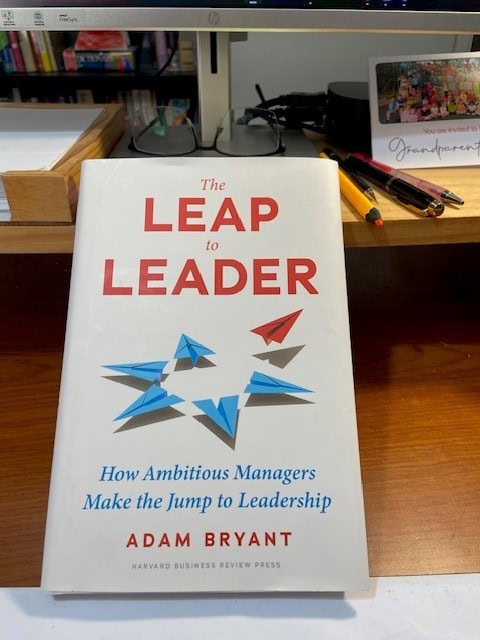
The transition to leadership involves a realization “that you are fully accountable, that you must grapple with the hardest decisions, and that you need to let go of doing the work that earned you promotion after promotion earlier in your career.” Such is how Adam Bryant introduces his newest book ‘The Leap to Leader’ (2023, Harvard Business Review Press). Bryant is an author I very much respect and enjoy his regular contributions to PWCs digital newsletter Strategy+Business. His experience as a managing director, leader, leadership coach, and author means he brings a wealth of practical experiences and insights, not to mention the hundreds of CEOs and other senior leaders he has interviewed for his books. This latest book is written for managers wanting to move into a leadership role, irrespective of where they are in their career journey, drawing on the experience of many who have gone before.
There is much to like about this book, including that he challenges the reader to understand the important of knowing why they want to be a leader. I also appreciate that the is sympathetic to the role of managers, and the part this stage plays in preparing people for leadership, especially when management is done well. There are numerous tips on how to maximise promotion opportunities that are really just examples of best practices for managers. The book concludes with a brief introduction for new leaders, which is also a good reminder for existing leaders of what we should be doing and doing well.
This is an excellent book and is highly recommended.

In a world that is constantly pushing business to be looking for more and more efficiencies, a potential sleeping tiger for Small -to-Medium-Enterprises (SMEs) is lurking in the form of radio advertising. Using radio advertising as a marketing tool not only utilizes one of the most effective advertising options, but with a little bit of thought, can also make a positive impact on employee commitment and pride in the organisation.
SMEs are faced with multiple avenues to advertise, including print, web-based, television, and radio. Each has their own strengths and preferred context. However, advertising can also be very expense and the conundrum for SMEs is balancing cost and audience reach. While TV advertising is considered by many to be the gold standard, it is also often too expensive for many SMEs, especially those in the social services sector.
This is where radio advertising can play an important role. Rather than just being an audio approach, radio can conjure powerful imagery in the mind to capture attention and enhance retention of the message[1]. This creation of mental pictures by listeners visualizing what they hear is a major reason why radio often outperforms in better helping an audience remember what is heard[2]. In addition, radio has a persistent high reach and retains much of the audience during ad breaks, rather than losing them to “channel hopping”[3].
A 2019 study in Finland[4] looked specifically at SMEs and radio advertising and found a number of very useful insights. Importantly, SMEs that invested in developing specific brand music for their advertisements were most effective in building brand awareness. Radio advertisements, while being comparatively easy to create, are very cost-effective yet high in impact in increasing awareness of company name and brand. Succerssful radio advertisements will typically avoid price-competition, instead focussing on highlighting the values of the company. The other key ingredients from this study noted that a good radio advertisement has good creativity, and where possible uses a live read rather than a pre-recorded message. When done well, radio advertising has a good return on investment, is cost-effective, and has good audience reach. The use of repetition is important, as noted by a different study that concluded typically between 4 and 17 repetitions are optimal, with more in the early stages and fewer once it is established[5].
But where radio advertising can add additional value for the business is with employees. Thinking of your employees as internal customers, and remembering there is value in ensuring your marketing approach also speaks to them can bring much value to the organisation[6]. Research found that there can be a positive impact on front-line customer-oriented employees because they can then understand the role they have played in helping to create positive outcomes for the organisation, which then enhances their commitment to the organisation[7]. That is, advertising can have the effect of providing “meaning both for consumers and for organizations and their members at one and the same time”[8].
In particular, research has found that “employees interpret, evaluate, and react to communications of and about their organization.”[9] They are also influenced by their organisations advertising. Where such advertising features employees it is even more impactful because the employees feel more involved and that their contributions are more valued. The caveat is that the organisational values espoused in the advertisements must align with what the employees actually experience, otherwise there is a negative impact. Customer focus is enhanced when employees take pride in organisational ads and when employees are portrayed accurately[10]. Where there is congruity or fit between the employees and the organisations values, employee retention and productivity increase[11]. Numerous studies confirm that organisational pride fosters customer-oriented behaviour[12].
A carefully planned and executed radio advertising program can be the secret weapon SMEs are looking for. Not only is it a cost-effective and proven tool to reach audiences, but when involving employees in the process, the positive impact on their pride and commitment to the organisation will result in productivity gains and higher employee engagement. Everyone wins.
[1] Michelon, A., Bellman, S., Faulkner, M., Cohen, J., & Bruwer, J. (2020). A New Benchmark for Mechanical Avoidance of Radio Advertising: Why Radio Advertising is a Sound Investment. Journal of Advertising Research. December.
[2] Russo, V., Valesi, R., Gallo, A., Laureanti, R., & Zito, Margherita. (2020). “The Theatre of the Mind”: The Effect of Radio Exposure on TV Advertising. Social Sciences. 15 July.
[3] Michelon et al, Ibid.
[4] Pitkanen, J. (2019). The Effectiveness of Radio Marketing in Branding – Perceptions of SMEs. Master’s Thesis. Jyväskylä University of Applied Sciences
[5] Pedreno-Santos, A. & Garcia-Madariaga, J. (2021). Analysis of effective recall in radio advertising. Journal of Communication Management. 26(1).
[6] Gunnesson, E. (1987). Using Internal Marketing to Create a New Culture: The Case of Ericsson Quality. Journal of Business and Industrial Marketing. 2(3).
[7] Schultz, S., Martin, T. & Meyer, H. (2017). Factors Influencing Organization Commitment: Internal Marketing Orientation, External Marketing Orientation, and Subjective Well-being. Journal of Management Development. 36(10).
[8] Du Gay, P. (2000). Markets and Meanings: Re-imagining Organizational Life. In M. Schultz & M. Hatch (Eds.). The expressive organization: Linking identity, reputation, and the corporate brand (p. 72). Oxford University Press.
[9] Celsi, M. & Gilly, M. (2010). Employees as Internal Audience: How Advertising Affects Employees’ Customer Focus. Journal of the Academy of Marketing Science. 38. (p. 520)
[10] Ibid
[11] Matanda, M. & Ndubisi, N. (2013). Internal Marketing, Internal Branding, and Organisational Outcomes: The Moderating Role of Perceived Goal Congruence. Journal of Marketing Management. 29(9-10).
[12] As an example, see Kraemer, T., Weiger, W., Gouthier, M. & Hammerschmidt, M. (2020) Toward a Theory of Spirals: The Dynamic Relationship Between Organizational Pride and Customer-oriented Behavior. Journal of the Academy of Marketing Science. (February).
As smart as leaders think they are, they’re not perfect and need diverse perspectives to provide a broader range of options and ideas.
An article by McKinsey & Company provides practical and workable ways for leaders to introduce “contributory dissent” into their organisation. This is where “individuals and groups air their differences in a way that moves the discussion toward a positive outcome and doesn’t undermine the leadership or group cohesion. Organisations where healthy dissent exists have a “culture where constructive feedback is expected and where communication is forthright.”
How leaders can encourage contributory dissent
The aim is to “institutionalise the practice [of dissent] within an organisation and empower employees to share their ideas freely and productively.” Leaders should:
How leaders can establish psychological safety
There is a “strong correlation between leadership behaviours, collaborative culture and resistance to mental health problems and burnout.” Leaders should:
How individuals and teams can engage and dissent
Individuals and teams “must also have the right mindsets and skills.” Leaders should:
By creating an environment where contributory dissent is freely practiced, employee engagement is strengthened, hidden insights are unlocked, and help is provided to solve challenges. Encouraging contributory dissent is not necessarily easy for leaders, who often have fragile egos and a messiah complex. But the benefits are proven and rewarding.

Significant strategic decisions require thorough discussion before reaching agreement on the appropriate course of action. But how much agreement is enough? A recent article in the online magazine Knowledge by INSEAD (READ IT HERE) tackles the question of voting on major strategic decisions and how many need to agree before the decision is considered approved. Spoiler alert: the article doesn’t ‘specify a number but does provide extremely useful insights into how people vote.
Often there are high thresholds for approving major projects (often 67% or 75%), but this can be fraught with issues, particularly if the people voting are competing with each other for scare company resources. It is not uncommon for the threshold to be lowered (say to a simple majority) in order for projects that may yield significant results to get approval. But the authors research has found there is an unintended consequence to this – “individuals [become] more conservative about how they vote and reluctant to voice their support.” The research also indicates that when people realize the difference their individual vote can make, they “begin to scrutinize proposals more carefully and become less inclined to approve new investments, even those with strong potential for success.”
In searching for why this may be the case the evidence found “that a high threshold makes individuals more relaxed about how they vote, while a lower threshold causes them to be significantly more cautious.” This impact was found to be quite substantial because more power has been given to individual decision-makers who feel they don’t have enough information to make the right call.
The article does provide some suggestions for organisations to think about different approaches to the dilemma:
It is a very interesting and practical article well worth reading in its entirety, and which challenges management “to reflect on how to make decisions,” a process that is often assumed but rarely evaluated.

Organisations have a problem with trust. A recent online article from Deloitte Insights [READ IT HERE] notes that “well-meaning leaders, executives who likely trust individual workers, don’t trust “workers” as a group.” As such, the article asserts that “leaders often treat workers like naughty children to be kept in line, regardless of their trust in individual workers.” This impacts on the policies and processes implemented by leaders which often indicates this distrust, perpetuating a vicious cycle whereby workers trust in the organisation is eroded, and away we go… Yet when workers trust the organisation and management, they tend to be more productive and happier workers, reducing turnover, improving engagement, producing superior productivity and job quality.
Like managers, workers may also trust the manager as an individual, but not in their role as manager. This distrust can come from the decisions of the organisation (as opposed to the individual managers decisions), or from their colleagues’ interactions with the manager. Addressing this, the authors note that “workers develop trust in an organisation, and the managers representing it, when they feel that the organisation is enabling them to be productive and have purpose and impact.”
What then, does a trustworthy organisation look like? From the article, it is characterised as a place where “workers are empowered to be productive”, and information, decisions and processes are openly shared.
The steps to create this kind of trust, as suggested in the article, includes:
The concluding paragraph of the article is a great summary: “The assumption has long been that low levels of trust have lowered productivity, when it’s possible that causality runs the other way around. Trust is a symptom rather than the cause, with high levels of trust a sign that an organisation has created a productive and fulfilling work environment.”

Typically, those of us in the nonprofit sector have a deeper purpose and drive for the work that we do. This doesn’t come without cost, and a recent report form McKinsey & Company (READ IT HERE) notes that workers in nonprofit organisations are particularly vulnerable to burnout, and more so amongst the organisations leaders. Also of concern is that the ripple effects of this travels through the organisation and beyond to include families, organisations, and communities. As one manager reported saying, “We hire great people but struggle to hang onto them.”
The report is based on a sample of Australian nonprofit organisations and their leaders. Of concern also is that many self-identified as ‘in orange’ or ‘in red’ zones – indicating they are approaching or experiencing burnout.” Only 11 percent felt they operate in a healthy level of stress. Even more disturbing is that of those who are in the orange or red zones, they “reported having felt like this for extended periods of time – many for months on end.” This leads to numerous detrimental effects for the people concerned.
In unpacking what contributes most to burnout, the respondents self-reported work culture, financial concerns, and lack of control. However, when participating in an interactive ranking exercise, “the highest-ranked factors were quite different.” Instead, “the top stress factors were predominantly physical.” Unpacking this, three insights became evident:
This last factor is an important one, as the report notes that nonprofit leaders don’t tend to look after their own needs and are poor role models of this. Other research referred to by McKinsey provides some interesting data on the numerical impact of this on productivity, but “in short, people who take care of their own needs are more effective as leaders.”
Providing some suggestions as to how to reduce burnout, the report firstly challenges the tradition that burnout is the responsibility of the individual, and instead the organisation needs to pay more attention to it. Specifically, the report suggests leaders prioritize the following:
In summary, “when leaders ‘walk the walk’ in reducing stress, they can create organisations that are better able to serve the country’s most vulnerable.”