It took me just under four hours to read Seth Godin’s latest book ‘The Song of Significance’ (2023, Penguin Business), and it was an engaging, thrilling, voyage of discovery. Disguised as a book on leadership and teams, it is much more. Godin refers to it as a manifesto, which it really is. He uses countless stories and examples to give colour to his thoughts on the current state of organisations and management. In doing so, he challenges the reader to rethink the very essence of organisational purpose.
It is very uncomfortable to be challenged to think about our organisations and our own leadership, and whether what we currently do is what we should be doing. Further, to this is being reminded that organisations and organisational thinking has gone unchecked for decades, gradually dehumanizing processes, people, and interactions. Leaders are urged to stop doing things to people, but rather with and for people.
The goal of significance is put before the reader, to engage in work that actually matters; to choose significance over convenience. Godin asserts that real leadership is the art of creating something significant, and creating the conditions for other people to do work that matters. The challenge is also posed that the goal should not be more, but better.
The journey in this book is high-speed, which many brief stops along the way to explore issues like customer satisfaction, effective meetings, job design, the role of feedback, and so much more. No aspect of organisation life is off-limits.
My mind is still trying to process the many salient issues raised, but the overarching challenge that is reshaping my own perspective on leadership is that leaders are being urge to “…not only reclaim the agency that is our humanity, but to open the door for others to find it as well” (p. 187). A very worthy read that is highly recommended for anyone in an organisation.

New leaders frequently feel they have been recruited to “fix” some organisational problem, usually by imposing some new strategy and associated renewal process. New research by Michael Jarrett and Russ Vince, as reported in a recent INSEAD online article (CLICK HERE TO READ) challenges the effectiveness of the “heroic leader” who outlines and drives the transformation process. While there may be some positive impact from this during the transformation process, it is difficult to maintain in the long-term. Usually this is because of the “emotional stresses that such centralised authority places on the organisation, and specifically on those in top management roles.”
To minimize the chances of such failures occurring, the authors note four key actions for Leaders:
Offering a further piece of general advice, the authors strongly advocate walking around and listening to staff, which shows “that you care and respect them.” Building relationships and trust within your team can ensure your “people are empowered and engaged through every step of the transformational journey.”

Are you burnt-out yet? Don’t worry, it may just be a matter of time. A recent article HRM Online (READ IT HERE) notes that “nearly two-thirds of Aussie workers are experiencing high levels of burnout.” Typically, at this point most articles would now launch into a 5 (or 10 or 15) point plan of how the organization’s leaders need to address this issue for their workers. Instead, the article essentially asks, “who is looking after the leaders, who are feeling the stain even more?”
Recent changes in employer’s legal responsibilities around psychological hazards puts added stress and strains on the leaders. Not surprisingly the leaders’ levels of burnout are higher than their teams. This creates a difficult challenge for leaders.
The advice in the article is for organisations to take a holistic approach, beginning at the top of the organisation, in order for leaders to be able to manage their new additional responsibilities. Interestingly, the article notes that “leaders are highly contagious when it comes to metal health and wellbeing in workplaces.” That is, if leaders are feeling “less burnt out themselves, it’s less likely their team will be too.” There are a number of suggested strategies for leaders and organizations to try in order to keep their leaders psychologically safe.

Organisations need success measures in order to track progress of their strategy. The tricky bit is choosing the right metrics to achieve this. A recent research spotlight article in the online UNSW BusinessThink (READ IT HERE) reviews a just published article by UNSW academics Professor Mandy Cheng and Dr Linda Chang and Dr Kelly Wang from UTS that addresses the phenomenon know as “surrogation propensity” (find the article here), which can adversely affect effective strategy achievement.
Surrogation propensity occurs when achieving a strategic measure substitutes for achieving the strategy itself. The example in the article notes the situation when attempting to improve health, focussing solely on the number of steps each day neglects “other crucial factors like nutrition, posture, and mental health.” This “managing by numbers” emphasis can lead to strategy surrogation and distract from “a more balanced approach to measuring success.”
The review quotes from the paper in explaining this further: “Strategy surrogation happens when managers make suboptimal decisions because they focus only on their performance measures and forget that these performance measures are only an imperfect representation of their strategy. In other words, managers sometimes mistakenly think that performance measures and strategy are the same thing when performance measures only capture some aspects of the strategy.”
The authors recommend a potential option to reduce the impact of strategy surrogation by “implementing a flexible performance measure system (PMS) [that] can reduce strategy surrogation and improve managers innovation investment decisions.” When managers have the ability to modify and “customise the PMS in response to emerging needs when implanting their strategy’” they have flexibility and buy-in, effectively utilizing a bottom-up approach.
Rather than being stuck trying to constantly meet performance measures that may or may not actually impact strategy, flexibility encourages innovative thinking that can achieve much greater results. The article goes into much better nuanced explanation of the process, and is well worth the time reading it. It may even revolutionize the way you achieve your strategy.

“Most managers still don’t know what they are doing.” Authors Mark Horstman, Kate Braun and Saran Sentes don’t hold back in their latest release, the second edition of the very successful The Effective Manager (2023, Wiley). They double down on this by noting that “Most managers are terrible at the most important thing they’re supposed to be doing. We’re supposed to e getting top performance out of the people we are managing. But most of us aren’t.”
This book is written specifically for manager, not the CEO. It’s major emphasis through each chapter is what you do next – in detail. Tackling the most basic issue of managing people and getting the most out of your direct reports, the book highlights and explores the four most critical behaviours of managers:
And again, the book provides tools within each chapter, including scripts and details on how to actually put into practice the points made. There is also free access to their website where there are a multitude of other free resources to make use of.
This is an excellent book, especially for new managers, or managers who may be struggling with their role. The authors are so confident in their content that they offer a no condition money-back guarantee on the price of the book if you are not satisfied. A highly recommended book.

Organisations and leaders are operating in the largely unchartered waters of the post-pandemic world. A world that is also facing economic, political, environmental and workforce challenges that many of today’s leaders have not yet faced in the context of their roles. The 2023 Future of Work Outlook published by PwC (read it in full here), aims to equip leaders for navigating these challenges by focusing on 8 key areas for 2023.
The report suggests the following 8 trends for 2023:
Rising costs and wage pressures will likely mean organisations are more cautious with their finances. The word of caution here is to not forget about long-term strategy altogether, especially investment in learning and development. It is hard enough to get staff in the door, but we need to keep them once they are in!
With unemployment rates hitting their lowest levels in decades, the race is on to secure talent with the right skills. A couple of factors impacting this include a decline in immigration over the pandemic years, and an ongoing decline in the number of school leavers choosing to study at university. Having a workforce plan that supports your talent management strategy over the coming years is key.
The feedback from employees is clear: hybrid work is here to stay. Free food and superficial perks are not enough to entice workers back to the office long-term. It is about an environment of collaboration and connection that a person can only get from being in their office with their colleagues.
The AWM is 2023’s answer to the Great Resignation and ‘quiet quitting’. People are continuing to create and enforce boundaries around overwork with poor conditions, in jobs they feel are not purposeful.
This refers to the struggle of monitoring employee activity while working remotely. For example, using monitoring technology on company computers. The argument in this report is that it does not facilitate an environment of trust and needs to be reconsidered.
A reminder that businesses now have a legal obligation to manage the risk of psychosocial hazards in the workplace. These include things like job demands and clarity.
A suggestion that rather than continuing to cut things away (which in turn, increases workloads), let’s take the opportunity to review whether our foundations and design are actually still correct. Is our structure and job design optimized for success, or are we still playing Jenga when we should be playing Lego?
The bottom line…we need to rebuild our in-person networks and communication. These formal and informal networks are such important levers for organisations.
One thing common to all these trends is a return to basics. Coming out of a tumultuous period and into another, it is more important than ever to ensure we are doing the basics of business and management well. The key questions at the end of each section in the report were particularly helping from this angle.
Organisations survive or perish on the decisions leaders make. So, are leaders ensuring their decision-making processes lead to the best decision in the most timely manner? Unfortunately, no.
A recent McKinsey & Company report shows while leaders spend nearly 40 per cent of their time making decisions, they report the time as being of poor use and leading often to decision fatigue. McKinsey has quantified the effects of ineffective decision-making on a typical Fortune 500 company as being the equivalent of 530,000 days per year, or around $250 million in annual wages. That’s a significant cost.
So, how do you make better decisions? The report shows the solution for organisations seeking to streamline decision-making is agility. The advantages of being agile include:
A strategy to develop agility is to categorise the types of decisions and adapt the approach accordingly. The three categories suggested by McKinsey are:
Adding to this, McKinsey also suggests the following four actions for agile decision-making:
Action four implies delegating decisions and, as noted in the report, effective delegation means empowering employees “by giving them the authority and confidence to act.” It also means giving employees “the tools they need to make high-quality decisions and the right level of guidance to do so.” To help achieve this, McKinsey suggests:
The report expands on all the points noted in this summary and includes many others. It is an excellent read that will challenge your decision-making processes and provide practical tips for you to consider.

What to do when experiencing uncertainty and ambiguity is a conundrum all leaders face at various times in their careers. A recent article ‘Flourishing in Ambiguity’ in the online Deloitte Insights Magazine 31 (read it here) notes that in “such circumstances there may be insufficient data to see an obvious course of action, or worse, using such data may result in the worst possible option being taken.” Even still, it is necessary for leaders to find ways to flourish amidst ambiguity.
The authors propose an alternative to just deciding to act, suggesting considering acting to decide. That is, instead of going “all in” on one option, investing in many small actions “that help improve our understanding of the current situation and foster the discovery and development of all options and possibilities available to us.” During this process, some options may well prove to be unworkable or inappropriate, while others may become the “logical next step for the organisation.”
This ambiguity can be problematic for managers and leaders who prefer a decisive single course of action based on solid data (which may be unavailable). Instead, engaging with the ambiguity and learning from it, and exploring smaller actions can reveal a best way forward. This acting to decide requires managers and leaders to “sense and understand the landscape, sensing possibilities, and pivoting towards opportunities and around challenges as they arise.”
Exploring and learning within uncertainty rather than prematurely committing to a decisive (and potentially disastrous) action can mean the different between thriving, just surviving, or even failing.

What does it mean to find your passion at work? A recent article by Tina Kiefer of the Warwick Business School (READ IT HERE) argues that finding your passion at work can actually improve performance, but there are downsides. Kiefer notes that “positive emotions, such as joy, happiness and pride, happen when we accomplish something that brings us closer to a goal.” She cites examples such as finishing a work project or a positive social experience with a colleague.
The positive outcomes of these include improved “employee wellbeing and job performance,” as well as better motivation and engagement. Workplaces and employees benefit through better work quality, enhanced teamwork, trust and a sense of belonging. In addition, the article notes how “fun and joy at work can broaden our horizons” which can lead to employees being more “willing to try new things and engage in different kinds of behaviour.” Interestingly it also notes that “people enjoy their work more when they are in a hybrid working environment, spending at least part of their week working from home.”
There are potential downsides to joy and positive emotions at work, at least as perceived by some. One such perception is that “joy and fun can be a health and safety risk or make it difficult to uphold professionalism.” Another is the potential that some may “feel excluded and alienated if they cannot or don’t wish to participate in social activities or camaraderie.” And a third is that people having fun at work may be viewed “as not taking the job seriously or not having to work hard.” Despite these, the potential benefits generally outweigh the negative, and are worth making a conscious effort for. However, it is also worth noting that “the magic doesn’t just happen by putting people in the same place.” But the effort is worthwhile to foster increased creativity and motivation in employees.
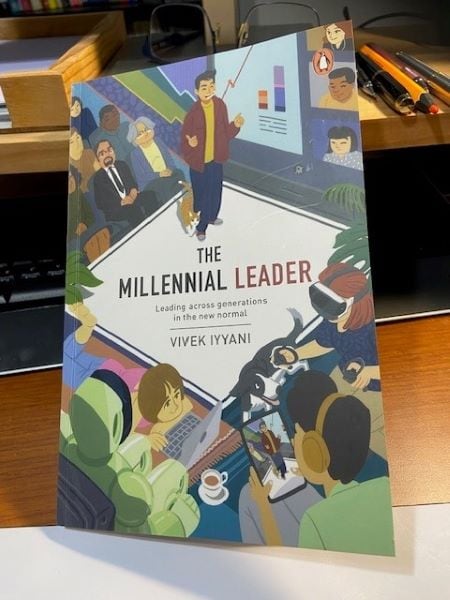
I love reading the classical foundational leadership literature, and I think much of it is timeless and plies across culture and generations. But every now and then something comes across my desk that I just know is going to shake those long-held ideas and add something new and significant to the “must know” principles of leadership.
One of these is the new book by Vivek Iyyani, The Millennial Leader (2022 Penguin). Is one of those books that grabbed my attention from the outset. Initially I assumed the title meant this book was written for Millennials (born 1980 – 1995) but upon reading it I soon discovered it is for every leader who is now leading in a Millennial context – the new normal of multiple generations and in a more connected yet distributed world than ever before. In other wors, it is for every current or aspiring leader.
Drawing directly from the Covid experiences, Iyyani notes that as a result “the entire concept of leadership is being redefined.” The rest of the book builds on this premise and provides the reader with well explained ideas and tool for this new era of leadership; Specifically, the book proposes five key approaches:
The author is deeply invested in wanting leaders to adapt and provide relevant and effective leadership in this new normal in which we find ourselves. The reader is also offered a pool of free resources to help translate the ideas of the book into practice. A nice touch. A highly recommended book.