Starting well is important and for the new CFO the are facing a myriad of business challenges, let alone adjusting to a new role. And the CFO role has evolved considerably to now be much more collaborative and human-centered, while also needing to keep abreast of and oversee rapidly changing digital initiatives. A recent McKinsey & Co. online article (READ IT HERE) has “identified seven key mindsets and practices that new finance leaders can commit to right from the outset, to help jumpstart and sustain ling-term value creation.”
Overall, the advice from the article is to “resist a setting for inaction or incrementalism and hit the ground running.” Ready, set, go!

Argument, counterargument, robust discussion, and the exploration of ideas was how the morning of July 1 was spent. The Ella Hughes Chapel was charged with anticipation as the annual Great Debate was conducted, watched by students and staff members.
As part of their final assessment, students of the BBUS36090 Professional Ethics class debated a case study exploring whether an employee should Whilstleblow on some dubious practices within the organisation. It was one of several complex real-world issues from the case study the students had to investigate and report on. Their task was to identify the numerous ethical issues in the case study, and the use a decision-making tool of their choosing to recommend how to address the main issue of whistleblowing.
This final assessment was the culmination of a semester spent in weekly lively discussions exploring the multi-dimensions of ethical issues facing organisations and people today. This course and the associated activities ensure students are not only exposed to the various perspectives and issues but are also equipped with ways to help them think about and develop positions. The intention is not to prescribe answers, but to broaden their views of issues and provide tools to help them consider and evaluate alternatives.
The supportive audience listened to the various arguments form the two teams and enjoyed the robust exchange of ideas and arguments. Both teams did an excellent job and deserved the affirmation given to them from the audience. This form of authentic assessment is typical of the Avondale University Business Degree which puts the students into real-world scenarios, preparing them for their careers, which are just around the corner.

Given the volatile, uncertain, complex, and ambiguous (VUCA) business environment we operate within today, all team are going to face adversity in some form. The difference between teams that thrive and those that don’t is team resilience. This is the thrust of a new book from Bradley Kirkman and Adam Stoverink called Unbreakable: Building and leading resilient teams (2023, Stanford Business Books).
Kirkman and Stoverink are two distinguished business academics who have both contributed widely to business thinking through their publications and books. This book is based on their extensive involvement with hundreds of companies on five difference continents and robust research techniques.
Using the famous true but tragic story of a small team of smoke jumpers in the 1949 Mann Gulch (USA) wildfires, the authors draw lessons about building team resilience. Beginning with the learnings from Mann Gulch, the four team pitfalls are exposed. This provides the foundation for the main emphasis of the book, in which four team resilience resources are outlined and discussed. The recency of the book allows the authors to dedicate a chapter for leaders that addresses leading teams in a crisis, and another specifically dealing with remote and hybrid teams.
By using frequent examples and illustrative stories, the authors convey their message in a very relatable and memorable way that is practical, yet evidence based. The tools to help you assess your teams are also a nice addition. This is a great book for anyone involved in teams, irrespective of whether you are a leader, and is a very enjoyable read.

Are you still the best person for the job? A recent article by Adam Bryant in Strategy+Business (READ IT HERE) provocatively challenges leaders to continually reassess their suitability for the role. The questions he suggests leaders contemplate is whether it is time to fire yourself.
Bryant proposes that “being able to assess your own work accurately is particularly important in this era of relentless disruption, given that simply maintain the status quo is a sure-fire strategy for falling behind.” Acknowledging that this can be a difficult thing to do, the article notes “we can become overly invested in the people we’ve hired and the initiatives or strategies we’ve launched.” It also notes that all too often “we look for clues that reinforce the smartness of our choices rather than constantly questioning them.”
A number of very interesting examples of leading global CEOs is shared, which is both illuminating and instructive on how this can be achieved. This process is considered an essential leadership skill.
To conclude the article Bryant suggests you think about who might replace you in your job and then consider “what steps might they take because they are not invested in everything you’ve done, that would make you think, why didn’t I do that?” An interesting challenge for us to consider.
[x_author id='']
It’s time to consider what expenses I can claim in preparation for the completion of my financial tax year. This is the month to think about donating to charities or not-for-profits so you can make an immediate claim when you lodge your tax return after June 30. But be warned: your expenses are only tax deductible if you donate them to a registered deductible gift recipient (DGR).
According to the Australian Taxation Office, a DGR is an organisation that is eligible to receive tax-deductible gifts. Not all charities are registered as a DGR and, therefore, your gift may not always be an allowable deduction. For example, crowd funding campaigns through sites like GoFundMe, although a popular way to raise money, are not always administered by organisations that have DGR status.
How do you know if an organisation is registered? Search the Australian Charities and Not-for-profit Commission website.
What you are looking for should appear like this:
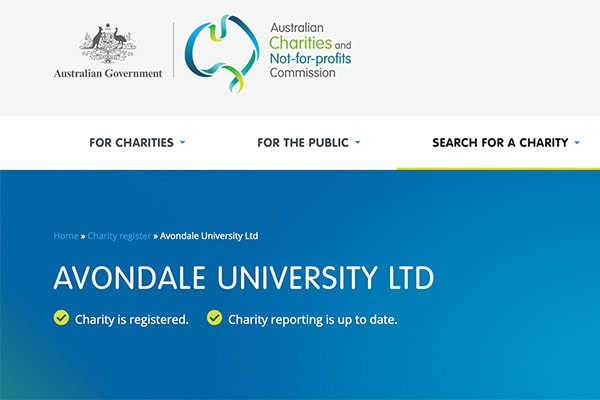
As you can see, Avondale University is a registered charity and its reporting is up to date. So, any donations you make to Avondale will be tax deductible and claimable this financial year when you do your tax return next month.
So, why donate to a DGR?
Photograph: Liza Summer from Pexels.
[x_callout type="left" title="Create Great Spaces" message="Help our brightest minds be the best they can be. Donate by June 30 to Create Great Spaces for learning on our Lake Macquarie campus. Donations above $2 give you a tax deduction in Australia." button_text="DONATE NOW" href="https://www.avondale.edu.au/alumni/giving/" target="blank" class="x-btn-yellow"]

HR professionals Australia-wide have shared their challenges and priorities for 2023 through the HR Industry Benchmark Report (produced by ELMO Software and the Australian HR Institute). I would recommend downloading the full report (CLICK HERE TO DOWNLOAD). And not just because of the information, but also because of the relief you will feel knowing your challenges are quite normal!
The report begins with an overview of priority areas for organisations, with workplace health and safety, and employee data security topping the list at number 1 and 2. With the tightening of WHS laws and an increase in cyber-attacks, this is really no surprise.
It then moves on to overview current trends and challenges, which are highlighted below here.
General:
Recruitment:
Onboarding:
Performance Management:
Learning and Development:
Payroll:
One of the key themes that emerged was an increasing use of technology to drive HR metrics and processes. Not only does this create efficiencies for HR professionals, but it enables data-driven decision-making and the ability to measure outcomes.
Overall a very interesting and useful report, not just for HR professionals, but for any manager who wants to stay abreast of what business challenges are looming on the horizon.
Using your head AND heart to help others is what compassionate leadership is built on, as noted in a recent online article in Industry Leaders Magazine (READ IT HERE). We can all no doubt recall leaders throughout our journey who are clearly compassionate leaders, and equally so there will be plenty of memories of those who were the anthesis of compassion. The article notes that “everyone can learn to be a good leader and infuse their leadership style with compassion.”
The ’how-to’ is really not that difficult and is evident when “people in power create work conditions where people feel supported, seen, and have fulfilling work lives.” By understanding both their own jobs, and the people they work with, leaders can “take the necessary steps to solve the problem, while working out a long-term solution.” It is true that it can take a bit more time and effort being a compassionate leader, especially in the early days of adjusting, but the benefits far outweigh these.
As noted in the article, there are a number of potential benefits to compassionate leadership. Compassion inspires loyalty and increased productivity. Burnout is reduced amongst workers who show more compassion. And the point is made that kindness increases self-esteem and protects you from chronic diseases like obesity, diabetes, and cancer. Too many leaders also “assume that harsh criticism will motivate employees to perform better, yet such practices result in less likelihood of being promoted.” Finally, the article quotes research that found “those who are kinder and more generous tend to have higher incomes compared to selfish people.”
With such clear benefits, its intriguing there are not more compassionate leaders “promoting and delivering compassionate cultures at work.” Perhaps now is your time to step up.
American contemporary business author Louis Bone once quipped, “I am definitely going to take a course on time management . . . just as soon as I can work it into my schedule.” Being busy afflicts us all. Numerous courses, books and charismatic gurus offer the latest trend to “work smarter, not harder.” If promoted often enough, this becomes entrenched as fact without any foundation.
Rather than jump on the bandwagon, an article in Insight by the Kellogg School of Management at Northwestern University offers five ideas grounded in research instead of populism. Each provides fascinating examples and practical suggestions to help you schedule your day. Here’s a summary:
Discovering proven practices that help with your scheduling is important because the way we spend our time can define who we are.

CEOs need to be thinking and dealing with both the now and then, but are struggling to find the time for the then. The PWC 26th Annual Global CEO Survey (download it here) has looked at nine key themes and found that things are changing, and CEOs are needing to adapt. The report is not a huge read, but it is an interesting one. A very high level summary for you follows:
Following the current trajectory is not an option if businesses wasn’t to survive. “Nearly 40% of CEOs think their company will no longer be economically viable a decade from now, if it continues on its current path.” Issues like skill shortages, technology disruption, demographic shifts, and social instability are changing the business environment and CEOs need to a “reimagination of company’s place in the world.”
Most CEOs are expecting some impact within the next 12 months from climate change, particularly impacting costs, supply chains and their physical assets. This is a long term problem that needs to be broken down into manageable chunks if CEOs are going to make any headway.
In the next 12 months it is inflation, economic volatility and geopolitical risk that are attracting most CEOs attention right now. In the five-year horizon it is these plus cyber risks. The challenge for CEOs is to avoid being blindsided by these longer term risks while trying to deal with the here and now.
Most of the CEOs believe there will be a decline over the next 12 months in global economic growth. The report asks whether “inordinate optimism a year ago has been replaced by excessive pessimism?” Will this impact effective decision-making? And will boards also succumb to this pessimistic outlook?
“In the current environment, CEOs report cutting costs and spurring revenue growth – but most don’t plan to reduce workforce or delay [M&A] deals. The consensus is that workforce churn is here to stay, so keeping workers happy and engaged “will be a mission-critical priority.”
CEOs generally are more optimistic about their won countries economies than the global economy. Strategies to address this include cybersecurity investments and shoring up supply chains.
Current operating performance is dominating the CEOs time, where as they would like to be spending more time “evolving the business and its strategy to meet future demands.” The main strategy to address this is to invest big in technology, including automation, upskilling and AI.
The responses from the CEOs “suggest that in many organisations, the conditions aren’t in place for managers and employees to run on their own towards major new opportunities or to independently spot and respond to disruptive threats.” The advice from PWC is for CEOs to “double down on setting a shared vision, empowering people to make decisions, and being visible champions for change.”
Where companies have a wide network of collaborators, new sources of value arise. And “companies are most likely to collaborate to create business value than to solve societal issues.” Can businesses continue to ignore societal issues?
It is a very interesting report, with many challenges for CEOs, especially those wedded to a traditional trajectory and mindset. This report challenges these and provides some practical advice on how to think about both now and then.
Everyone is a leader and impacts other people’s lives, whether it be within a family, social group, or workplace – everyone is a leader irrespective of formal titles. Leaders are not someone else, they are us. I resonate very strongly with this and so was immediately gripped by Kirstin Ferguson’s new book Head and Heart: The Art of Modern Leadership (2023, Viking).

This excellent book is grounded in academic research and is tremendously practical in nature as it encourages us to rethink how we lead to best meet the needs of a modern world. And it is illustrated with relatable stores from a variety of leaders that show how we can easily integrate the ideas into our own leadership, irrespective of our leadership context. I really appreciate that Ferguson freely acknowledges (even encourages) us to disagree with her ideas as presented. I her words, “it is the act of reflecting and thinking about your leadership and considering alternatives that will help you develop as a modern leader.”
The book is divided into four parts, the first gives a context for modern leadership and introduces the central theme of leading with the head and heart. The second part focusses o leading with our heads, outlining four key attributes. The third part looks at leading with our hearts, which again has four key attributes and what they mean for us in practice. The final part is the integration of head and heart, bringing it all together. I also like that the book addresses modern leadership in hybrid and remote workplaces.
There are also a number of very useful and practical resources which adds even more to this excellent book, applicable for anyone at any point of their leadership journey, reinforcing that “everyone can be the modern leader we need in the world today.”