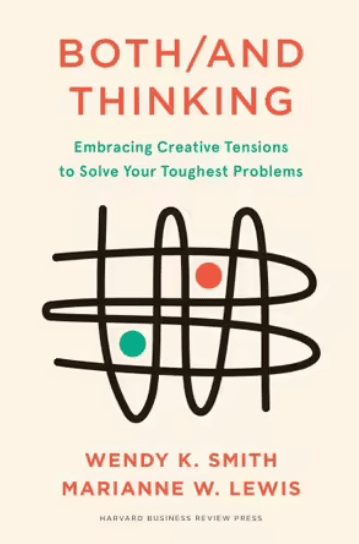
“Do we focus on the needs of today or tomorrow, or ourselves or others, of stability or change? Competing demands surround us. Yet lurking within these dilemmas are paradoxes – contradictory, yet interdependent tensions. To effectively respond, we must first understand more about the nature of paradoxes.” So beings the excellent new 2022 book ‘Both/And Thinking” by Wendy Smith and Marianne Lewis (Harvard Business Review Press).
This book is all about understanding paradoxes - like those mentioned above – and this understanding is vital to the solving of these complex problems of today. This book helps us to identify the paradoxes we might face, and also offers ways to navigate them so as to turn them into a positive. It is built around the idea of changing perspective from and ‘either/or’ option where we can only choose one or the other, but to see if we can have both – using both/and thinking.
The book, which is very well researched by two esteemed academics with bountiful practical experience, is divided into three parts. The first part explains the foundations of paradox and identifies four types. Part two looks at approaches to unpacking both/and thinking and includes four tools to put this into practice. The final part is a step-by-step process using specific examples at the individual, group, and organisational level.
Established and emerging leaders would benefit greatly from reading this book and adopting a new mindset that considers what is possible, rather than what we have to sacrifice. We highly recommend this new book.
When asked, “Who are you?”, how do you respond? I used to respond by telling people about my job. But I’ve realised I’m so much more than what I do. I’m a husband, father, Pa, brother, uncle, friend, colleague, accountant, PhD, neighbour, sports fan, and so much more. Who I am is complicated, and a lot of it is grounded in how I view the world and my place within it.
A worldview is defined by James Olthuis as “a framework or set of fundamental beliefs through which we view the world and our calling and future in it”[i]. This includes the foundations on which we base our life and our connection with the world around us. Many worldviews are based on some form of organised thinking. Examples include Christianity, Islam, postmodernism and naturalism (atheism). Without us necessarily realising it, our worldview reflects how we answer the big questions in life. Questions such as, What is a human being? What happens to a person when they die? And even, How do we know what is right and wrong?
The choices we make in response to these questions influence everything—our decisions, activities, relationships—including the way we lead. As noted by Valk et al, “leaders take action in the world from a clear place; they are anchored in a particular view of the world.”[ii]
For those of us who profess to be Christian leaders, what does it mean in how our leadership is expressed? Jim Sire notes[iii] a Christian worldview includes the following:
It’s time we reflected on how these actually manifest in our leadership. We can be smug promoting Christianity as our purpose, but does it really make an impact on what we do and how we view others? Are our leadership decisions and actions influenced by people who are created in the image of God and while fallen are redeemable? Or do we consider people expendable “assets”? Do we rely more on human reason than divine revelation? And are we reflecting God’s character and commands or interpretations that suit our convenience and objectives? Is the glorification of God and the seeking first of His kingdom reflected in our vision and mission? Or is our vision and mission platitudes wrapped in corporate speak?
It’s one thing to say—and even believe—our worldview is Christian and that our motives, actions and relationships are based on this. But Jim Sire issues a caution on which we would do well to reflect: “Our worldview may or may not be what we think it is. It is rather what we show it to be by our words and actions . . . . Our very actions may belie our self-knowledge.” [iv]
Perhaps now is the time to take a few moments to consider if
we really are Christian leaders, or just think we are?
[i]J. Olthuis, (1985), On Worldviews, Christian Scholar's Review. Vol. 14 Issue 2, p. 155
[ii]J. Valk, S. Belding, A. Crumpton, N. Harter and J. Reams, (2011), Worldviews and Leadership: Thinking and Acting the Bigger Pictures, Journal of Leadership Studies Vol. 5 Issue 2, p. 61
[iii] J Sire, (2020), The Universe Next Door: A Basic Worldview Catalog (6th ed.) pp 8-10.
[iv] Ibid. p.8
I worked as a chief financial officer for 20 years, so I’ve heard all the jokes and comments about the stereotypical CFO. They have their personality removed before being promoted. They’re the “no man or woman.” Or they lack imagination or innovation. The CFO of today needs to shun these stereotypes and step up as a fully-fledged innovation partner, otherwise their organisation risks missing a crucial voice in strategic discussions.
An article by McKinsey & Company addresses this issue and provides five actions CFOs can take to support innovation.
The article has other useful tips to help CFOs overcome the (often wrongly-attributed) stigma of being obstacles to innovation and instead be seen as valuable strategic partners in the innovation process.
Photograph: Sora Shimazaki from Pixels.
[x_recent_posts type="post" count="3" section="financial" orientation="horizontal" fade="true"]
Work–life balance: a notion that has moved from the category of aspiration to expectation. Where employees once spent their working lives searching for the elusive balance between professional and personal, they now view it as a baseline standard. This means employers can no longer rely on work–life balance as a competitive advantage but instead must view it as the norm.
I confess I believed this to be progress, and it is. But I’ve been rethinking my perception after reading this quote by organisational psychologist Dr Adam Grant:
“Work–life balance sets the bar too low. No one grows up dreaming of a job that doesn’t interfere with their life. We hope to spend our waking hours doing work that enriches our lives. A toxic job drains you. A decent job sustains you. A healthy job invigorates you.”
As someone who’s learning the art of balance but also has great passion for work, this inspired me. Actually, at first I was offended at the thought that even in those rare moments where I feel I’ve ticked the balance box, that’s not even enough! Moving past that, I strongly believe when we enjoy what we do, are challenged in healthy ways, and are happy in our organisations, it’s invigorating. When we’re invigorated, the work–life balance struggle turns more into a work–life rhythm where the various aspects of our lives are complimentary rather than competitive.
Work should be more than just a check-in, check-out 9-5 transactional experience. Thankfully, over the past couple of years, organisations have gained a new appreciation for flexibility. To move past the transactional experience into one that invigorates, we need to find (or create!) meaning in roles. Why is meaning so important? As this article points out, employees who find meaning in their roles tend to be more loyal, have higher job satisfaction, and be more engaged.
The good news? Meaning is there to be found if we look for it and there to be crafted if we’re intentional about it as employers. This interview with David and Wendy Ulrich has some good thoughts on the subject. A couple of the standouts are:
We spend so much of our lives at work, it’s only natural we’d want this time to mean something. When we feel it does, we’re spurred on to do it again. Not in a way that drains us, but in the way that we walk a little taller and smile a little brighter.
Photograph: Aziz Acharki on Unsplash.
Wanting creativity in an organisation and creating the environment for it to happen are two very different things. A recent article form Deloitte Insights (read it here) discusses how leaders can maximise the creative potential of their organisation.
While individual creative talent is a core ingredient, it is not everything. The article cites research that notes it is the interactions of individuals and teams that give rise to ongoing creativity. This implies that creativity is not just something we can have but is also something we do.
The authors have compiled a list of the 5 Ps for effective creative organisations. These are:
Effective creativity is the result of all these factors interacting.
The article also provides excellent ideas and suggestions on how to effectively allocate organisational resources towards these five components in order to maximise the creative potential of the organisations.
There is one additional crucial factor, which is having the executive and leadership team equipped to appropriately lead a creative organisations. This includes:
For any leader that would like to see creativity bloom withing their organisation, this is the article for you.
Trust is earned rather than gifted. For companies, what and how they communicate can build trust, or just as easily erode it. Mandatory reporting is one of the major publicly facing communication tools companies have at their disposal. The most common form of this is financial reporting, which has been honed during a century of requirements, and more recently overhauled following the corporate collapses of a decade ago. But growing in importance is sustainability reporting, which is becoming increasingly regulated, and even more so expected by stakeholders, many of whom are demanding to know more about companies.
A recent online article by Nadja Picard and James Chalmers in Strategy+Business (read it here) addresses this issue head on, with some excellent tips for companies. They highlight the risk companies face if they do not live up to their stated aims, and that sustainability reporting is very complex due to the diverse range of stakeholders with competing interests.
The article then provides three tips of companies on how to “deliver a sustainability strategy and provide meaningful…reporting that meets the requirements of its stakeholders.”:
Companies need to start somewhere with sustainability reporting, as then adjust as regulations and stakeholder expectations evolve. Companies will find that it’s a matter of something rather than noting if they want to build trust with the public.
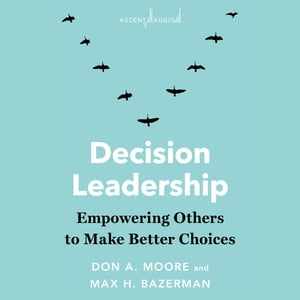
Organisations are “decision factories in which leaders are decision architects, enabling those around them to make wise, ethical choices consistent with their own interests and the organisations highest values.” This is the thrust of the new book by best selling authors, and the founders of behavioural economics, Don Moore and Max Bazerman. The book is called Decision Leadership: Empowering Others to Make Better Choices (2022, Yale University Press), and challenges the traditional characterization of organisations and leaders.
The authors provide a framework where leaders can step away from micro-managing, and instead rust their teams to make good decisions. Using the authors words, it stops the organisation “relying on one individual to play the part of heroic figure.” Their strongly argued position is that “leaders success depends not only on their ability to make good decisions but also on their ability to help others make wise decisions.”
There is extensive use of evidence throughout the book, including case studies to show how it all looks in the real world of organisations.
A key theme through is for leaders to not rely too much on their own intuition. A guide to improving decisions is provided. The tips include reviewing the role of confidence, using the advice of others, and the advantage of a culture of experimentation. Interestingly the authors also tackle head on how leaders can create more ethical organisations.
This is a highly recommended book for all business leaders and decision-makers at all levels with organisations. Buying this book will be one of the best decisions you make.
An article by business media brand Fast Company ponders the traditional work week. The article begins with an interesting history of the 40 hours, which sets the foundation for why this length may no longer be relevant.
The dynamics of our society have shifted since the Great Depression when we normalised the 40-hour work week. For example, today “most households have dual income earners,” with both typically being out of the home for most of the day. But COVID challenged traditional workplace practices. Working from home encouraged us to rethink whether we want a 40-hour week.
The article proposes two main reasons for reducing the 40-hour week. The first is to reduce burnout and to give people an opportunity to rest and recharge. Apparently, we have only just realised that too much thinking is bad for our health. The second is to attract top talent. Potential employees are not necessarily prepared to work the full 40 hours each week, and organisations may need to rethink their requirements.
Form is an issue to address before introducing a shorter week. Is it just another name for a four-day week? Or is it less hours each day? Or is it nine-day fortnights? And is it a one rule across the organisation or can employees choose from a range of options?
As noted in the article, perhaps it is less about hours and more about outputs, where employees have key performance indicators to deliver but can deliver them in a timeframe of their choosing. This takes a lot of trust, and perhaps we’re not yet equipped or ready for that. The authors propose it may yet take three to five years and a lot of experimentation (and courage) to find the right balance. But if other countries adopt the 40-hour week sooner, organisations may find themselves losing competitiveness on the global stage. It may yet be something that takes place whether we’re ready or not.
Photograph: www.freepik.com.
The way we think about strategy is all wrong.
This is the provocative assertion of author Richard Rumelt in this article in the April 2022 McKinsey Quarterly. The misperception to which he refers is that strategy is all about performance, usually financial performance. Instead, Rumelt takes the reader back to its core meaning, which is to overcome obstacles and challenges. He notes that strategy has “devolved into setting financial-performance goals rather than developing solutions to important and often imminent difficulties.”
Real strategy is difficult because it grapples with the big issues and opportunities facing an organisation, often with no clear way forward. With this mindset, strategy is forever dynamic because as new issues and opportunities appear, it is renewed as an ongoing problem-solving process.
A summary of the article is that strategy “is a way to overcome selected difficulties” not “a wish list of wonderful possible outcomes.” Further, strategy is not:
Strategy is embracing “the full complex and confusing forces of the challenges and opportunities being faced.”
Rumelt provides a number of insightful ways to then create strategy, using some very direct statements that defy conventional thinking about strategy.
If you are responsible for strategy, then this article will challenge your thinking.
Photograph: jannoon028 from www.freepik.com.
[x_recent_posts type="post" count="3" section="leadership" orientation="horizontal" fade="true"]
Being a board chair is a lot harder work than it sounds. A very recent article from Deloitte Insights (read it here) provides some initial findings from their discussions with over 300 board chairs across 16 countries (including Australia and New Zealand) and various industries about what it takes to be an effective board chair amidst the new demands.
Chairs acknowledge that the role is very demanding, but equally as rewarding. The chair plays a critical role in the success or failure of the organisation, not least of all through their relationship with the CEO. From these discussions, five fundamental areas of change emerged:
The article further provides advice on the eight leading practices for being a board chair, and the five for becoming a chair. These are very interesting and helpful for anyone involved in boards, or aspiring to.