Chaitali Mukherjee and Julia Lamm, in a recent Strategy+Business online article (read it here) propose that traditional hiring methods will no longer work in the new environment we find ourselves in. We are aware of the challenges that the last few years have bought us, and that many people don't want to return to how everything used to be. Employee turnover has increased in many places as employees redefine what working conditions they prepared to accept.
Businesses are generally being proactive in trying to accommodate employees as much as possible with employers now thinking of employees not so much as workers but “as whole human beings, with their own individual purpose that the business itself needs to reflect and support.
For example, but the flexibility being sought by employees is about is less about rewards and office hours, and more about “alignment with longer term career aspirations, short term life goals, passions outside of work, and their sense of belonging. People are seeking employers whose purpose align with their own values. This impacts the recruitment processes in that the prospect is also assessing the organisation for a good fit and purpose. It is no longer a one-way process.
The authors of the article make a very important point when they note that “for today's employees, the point of a career path is not necessarily to climb a ladder with a particular end-state in mind but to gain experience and pursue the individual’s purpose.” Consequently, the organisation needs to recognise employees want to move “within and across, and even outside an organisation – not just up – to achieve their goals.”
A cookie cutter approach to recruitment will no longer provide the best hires. Organisations need to be more nuanced and personalized, taking into account the values of the individual.
Avondale Business School was invited to the presentation of research results to her employer, made by our recent graduate Nerolie Dever, who graduated with her Master of Philosophy degree this year. The title of Nerolies’ thesis is “Perspectives on Key Competencies of Quality and Food Safety Internal Audits: Adding Value for Continuous Improvement”. Nerolie studied on a part-time basis over four years, and even managed to continue her research through two lockdowns and with working from home restrictions.
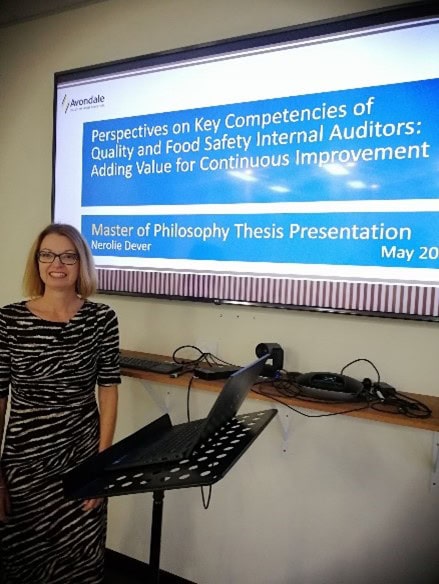
It is great to see that research being done by Avondale University graduates is actually being implemented in the workplace. Round table discussions after the presentation led to a plan for implementation and change to add value to the way in which her organization conducts internal audits.
Nerolie also published a journal article after submission of her thesis entitled “Model of Mitigation: Strategies to Utilise Unique Insider Research Opportunities” in the International Journal of Emerging Trends in Social Science in 2021 (see link to article)
Nerolie was supported in her journey by her supervisors Associate Professor Lisa Barnes and Dr Warrick Long, who were privileged to attend her graduation on 11th April, 2022.
Congratulations Nerolie – ABS is very proud of your achievements, particularly now that your recommendations are being implemented in the workplace. A true reflection of putting research into practice!
PWC recently released a Future of Work report that outlines how employers can win the war for talent by addressing the things that are important to employees (download it here). PWC surveyed 1800 Australian employees across Australia, industries, and positions to find what matters most to employees.
An interesting overall observation is that for 25% of workers, the reason they joined an organisation is not always why they stay, revealing and important implication for employers to recognize and continually address.
Grouping the key factors discovered in the survey into seven levers, PWC managed to get employees to rank these based on what they value most from an employer. Following is the list in order of importance:
However, within these ‘levers’ are a number of anomalies between what workers want, and what leaders think they want. There is a sizeable gap the shows leaders are quite out of touch with their workforces. For example:
| Preference | Leaders Beliefs | Employees Ranking |
| Values alignment between worker and organisation | 1st | 16th |
| On-the job learning | 2nd | 13th |
| Pay | 8th | 3rd |
| Working with good co-workers | 13th | 1st |
The report provides a number of excellent suggestions for leaders to consider in how to create an environment where workers are feeling valued and rewarded for their contributions. Implementing these can save an organisation considerable employee turnover and the associated cost associated with that. There are three big themes noted but the report breaks these down into manageable suggestions and ideas. The these are:
This is a great resource for leaders looking to improve how their organisation manages its workforce.
“Despite there being more than 15,000 books on leadership in print today, most organisations and most leaders show very little leadership.” So contend the authors of the recently released book Mavericks: How bold leadership changes the world’ (2022) ¸ by David Lewis, Jules Goddard and Tamryn Batcheller-Adams.

The authors are a mix of global business consultants and leadership academics bringing a wealth of experience and academic rigour. Their premise is based on a study involving people from over 50 different organisations from different sectors and countries. Their examples and stories are of humble people like you and me, but who have done abnormal things in abnormal normal ways to get abnormal results.
The issue they seek to address is why most leaders accept that the way things are done in our organisations and the outcomes that could be achieved could be so much better? That being the case, why do so few of us do so little about it? The authors also contend that maverick leaders are not born they learn. Anyone at anytime can be a Maverick. The role of a maverick leader is to see and seize possibilities. They are brave souls that are prepared to fail personally to succeed collectively.
The authors identify five core characteristics of a maverick leader:
Something that is also really valuable is that the book not only helps people become a maverick leader but to also create an environment where other people can release their inner maverick. The book also takes it beyond the individual to also consider maverick styles of leadership, maverick organisations, and maverick societies.
This book challenged me and invigorated me. It is a must read for anyone that actually wants to see extraordinary things happen.
I keep up to date with current and emerging thinking in leadership and management by subscribing to newsletters and journals that provide a constant flow of ideas and commentary. Naturally, the publications tend to reflect the ever-changing conditions of the time, which means there’s an ebb and flow to the narrative.
Over the past couple of years, the dominant theme has been COVID—how to cope with it, survive it and then move on from it. Much of the writing has been about ways we can manage hybrid working environments, remote workers, worker wellbeing and flexible working hours.
While browsing the most recent batch of newsletters and journals, I struggled to find anything not directly connected to COVID. Not a surprise, but it did strike me that it’s important not to get drawn too far away from the basics of good management.
But what is good management? It’s generally recognised the classic functions of management are based on the work of French engineer Henri Fayol, who developed the following cores:[1]
As management thinking continued to evolve, especially through the 1970s to 1990s, academic Henry Mintzberg developed the concept of three overarching roles of managers: interpersonal; informational, and; decisional.[3]. Since Mintzberg developed these, it’s widely accepted a fourth role be added, that of manager as coach.[4]
The context in which we now find ourselves doesn’t mean we forget about the four management functions and roles. Instead, great managers will heed these cores and apply them to contextually, perhaps as follows:
Important lessons from COVID have included the need for managers to develop and maintain positive relationships, especially in virtual remote or hybrid environments. The value of timely, clear and effective communication has been recognised, and great managers focus on this. Indecisive or autocratic management has been exposed as employees seek involvement in timely decisions that take a wholistic approach for the organisation. And great managers have embraced their role as coach by providing meaningful feedback to employees, creating learning environments and broadening perspectives.
We’re still finding our way in this “new normal,” but the foundational principals of good management are still as relevant as ever, and great managers never forget the basics.
[x_recent_posts type="post" count="3" tag="management" orientation="horizontal" fade="true"]
[1] Fayol, H. (1949), General and Industrial Management. Sir Isaac Pittman & Sons
[2] Schermerhorn, J., Davidson, P., Poole, D., Factor, A., Woods, P., Simon, A., & McBarron, E. (2017). Management: Asia-Pacific edition (6th ed.). Milton, Qld: John Wiley and Sons Australia
[3] Mintzberg, H. (1998). Covert Leadership: Notes on Managing Professionals. Harvard Business Review November-December
[4] Ellinger, A., Bostrom, R. (1999) Managerial Coaching Behaviors in Learning Organizations. The Journal of Management Development 18 (9) pp 752-771
Not all of us are innovative, but all of us can champion innovation. Of course, that is assuming we actually want our organisations to be innovative. I suppose if we are happy with the status quo and believe our services and products are timeless, then we don’t need to innovate. But before you get too comfortable, you might want to find out what happened to Kodak, Nokia, Video Ezy, or Blackberry. These are companies that didn’t innovate and now either no longer exist, or are just shadows of their former selves.
Bow that we are all on board with the need to be innovative, how can we foster a culture of innovation in our organisation? In a recent INSEAD Knowledge online article (read it here), Ben Bensaou provides some excellent ideas and examples of innovation in the workplace. To be honest, I just wanted to reproduce here the whole article word-for-word, because it is that good. However, a quick summary below may whet your appetite and encourage you to click on the link above.
The gist of Bensaou’s article is summarised in a quote he used from a Finnish CEO, Kari Kauniskangas, “It is important for me to make sure our people have the desire, will and freedom to find better ways of doing business. In search of new ideas, we have to give them permission to go crazy! But we also have to create boxes that define their focus and challenge people to innovate in the areas of greatest need.”
Addressing the CEO specifically, Bensaou points out that the CEO needs to “take on the role of chief reframing officer’, which is key to facilitating a culture of innovation. But the responsibility doesn’t stop with the CEO, with both middle managers and frontline workers also needing to be contributing. The article provides some excellent commentary around the contributions both of these groups can make.
The strength of the article is also in the examples provided, including ones in industries strongly bounded by tradition. If it can work there, it can work anywhere. In you ant to be successful in innovating, read the article, challenge your status quo, and reframe your culture to one of innovation.

Sunday April 10th, 2022 saw the first students to graduate from the new MBA (Master of Business Administration) program here at Avondale University.
Surrounded by proud Avondale Business School staff members Dr Warrick Long, Associate Professor Lisa Barnes and Dr Peter Williams, Mele and Homa are 2 of three graduates on what is a momentous day for the Avondale Business Schools post-graduate program. Since moving from the Master of Leadership and Management program to the MBA, enrolments have increased with particular interests from students in Nursing, Teaching and Business. Congratulations students – your hard work has paid off, we here at the Avondale Business School are very proud of you!
With no exams, and flexible online learning, the MBA program is proving popular. Should you wish to find out further information please go to:

Carolyn Dewar, Scott Keller and Vikram Malhotra, all senior partners at McKinsey and Company, have just released an outstanding new book - CEO Excellence (2022).
This book explores the “CEO Effect”, that is, the extent to which CEOs impact on a company so that it consistently outperforms comparable ones. It goes beyond looking at what a CEO does, to how the best CEOs work differently and why.
They chose 200 CEOs who over the past 20 years have consistently outperformed their peers and lasted in their organisations for a minimum of six years. Drawn from across diverse industries, geographies, gender and race. Survey all 200, but did in-depth interviews with 65 of them, which yields a 95% confidence level in the overall conclusions.
From these 6 key responsibilities of a CEO emerged:
Based on these 6 responsibilities, they then developed the 6 mindsets that distinguish the best leaders from the rest. They are confident that these mindsets will transcend time and remain true no matter the context. It’s not about being the best in all 6 things but being exceptional at balancing them all and integrating all the responsibilities simultaneously.
A key quote from one of the CEOs interviewed encapsulates this well by noting that being a CEO means “…spending time on things that no one else can in ways that magnify your effectiveness without getting mired in things that don’t make a difference.”
This book is very different from other books and studies because it is the first to go beyond describing what traits CEOs need, or what they do, to discovering what distinguishes the best from the rest. It also includes an excellent set of prioritization and assessment tools to help leaders in their development.
The book is excellent not only for existing leaders, but also for aspiring and future leaders so they can develop these skills in preparation for stepping up.
I highly recommend this as a resource for every leader.
Avondale Business School (ABS) recently enjoyed hosting some members from the South Pacific Division Adventist Technology team (AdTech) for a day of professional development and learning. Most of the participants are based in Fiji, and this was their first time visiting the Avondale University campus.
The discussions in the morning revolved around the presentations on working cross-culturally, led by Dr Erika Puni from the Avondale Seminary, and managing time effectively, led by Dr Warrick long from ABS. Both of these presenters have traveled throughout the south pacific, including living at different times in Fiji.

The team enjoyed lunch in the University Cafeteria with students, which was followed by a tour of the campus. A particular highlight happened while visiting the University Church where some students were playing the piano and singing, and invited the team to join in. The day concluded with a visit to and tour of Sunnyside, the home of Advnetist pioneer Ellen White while in Cooranbong, and a place of historical significance to Seventh-day Adventists.
Reflecting on the day, team leader Dean Tichborne wrote to say “Thank you so much for the time you spent with our team and the support you gave us… [they] are honoured they could be at Avondale to learn the vital skills of cross-cultural training and time management. The skills learnt will help our team in their career as well as serving Christ in our different ministries.”

Of course we all want our organisation to be the best, and we learn from other organisations who we see as being the best so we can implement what they are doing. Our plan is to copy the behaviours of successful organisations to achieve the same degree of success. It's a great plan and a very common one, except it doesn't really work when it comes to organizational culture.
A great article in the digital magazine Strategy+Business by John Katzenbach and Alice Zhou (Read it Here) highlight the difficulties of trying to copy culture They point out that a company’s culture is made up from that company's history and heritage, the journey of its development, and the resulting behaviours and emotions. These are things that cannot be transplanted from one company to another. They are as individual and unique as fingerprints
Rather, it is the identification of your company's unique element of habits, behaviours, relationships and ways of thinking that then enable you to gradually move in a direction to capitalise on your strengths. Using a culture survey can help with identifying the key elements of your company culture. When identified, you are able to focus on those things that can help you get from where you are to where you want to be. Your goal, according to the authors, is to create an effective culture “in which the elements that energize people are also those that support the organisations strategy.”
Don’t try to be like everyone else, find out what it is about your culture that can be strengthened so you become the envy of others.