“I’m busy, but don’t feel productive” – that is a common theme I hear from many people now days. So my attention was grabbed when I came across a report from McKinsey & Co in January this year (2022) about this very issues (you can read it here). The essence of the report is to suggest that the underlying issue is ‘the poor design and execution of collaborative interactions.’ That is, a lot of time gets wasted in our dealings with other people.
While there are more tools than ever to facilitate connecting with people, the quality of those interactions is deteriorating. As the report notes ‘indeed, most executives say they are spending way too much time on pointless interactions that drain their energy and produce information overload.’ I can relate to that.
To help us improve interactions in the workplace, the report suggests three broad categories of interactions and some tips for each. A brief summary of these are:
The report has many more ideas and suggestions on how to best achieve improved interactions within the organisation, which will improve productivity, speed and innovation. You just have to be willing to try.
Historically Human Resources (HR) has sat in the back seat of many organisations, acting as a support and letting out the odd back-seat driving instruction. With businesses turned upside down in the pandemic, HR was thrust into the driver’s seat to navigate redundancies, health and safety risks, the mass move to remote work, and a workforce now reevaluating their priorities and careers. McKinsey & Company spoke with over 80 chief human resources officers (CHROs) to gain insight into where they see the future of HR. The results are summarized in this article, noting that over 90 percent of CHROs believe the strategic function of HR is here to stay, and that HR needs to transform the way it operates maintain its leadership in the future.
These are the changes CHROs are prioritizing to transform their operating models according to the article:
During the interviews, the CHROs also identified four areas of focus that will support the evolution of HR from a supportive function to a critical leadership and strategic role:
Some of these suggestions may challenge us, and will certainly take time and effort to implement. The investment in the future of HR as a strategic partner and the resulting benefits across the organisation is well worth the journey.
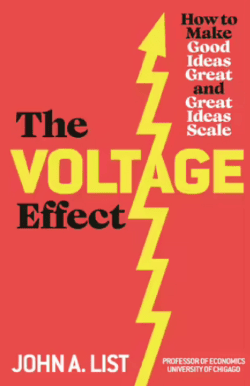
“You can only change the world at scale”, is the very strong assertion by John List in his new book The Voltage Effect: How to make good ideas great, and great ideas scale (2022). List is a distinguished economist who not only has an impressive academic career but has also been the chief economist at Uber and Lyft. He provides not only well researched ideas, but also real world examples of it in practice.
The main thrust of the book is identifying that scale is the one thing that is needed to take an idea and turn it into something that impacts the world and provides the “capacity to grow and expand in a robust and sustainable way.” He uses the term Voltage Effect to explain the science of scaling – why some ideas succeed in scaling up, and why others fail. The book identifies five key signature elements that stop an idea from taking off:
• False positives
• Overestimating how big you will grow
• Failing to identify if success is based on unique circumstances
• Unintended consequences
• Being too costly to scale
The argument is very hard to dispute, and the examples make it easy to see how it would work in practice for yourself. The book is very well organised and written, that can easily be read in bed, on a plane or by the pool.
It would appeal to anyone who is responsible for leading an organisation and wants to take ideas and give them the best chance of working at scale. Equally important for those who have developed ideas and are keen to see what it would take for them to be further developed for scale.
It’s a great book that was challenging and invigorating. Highly recommended.
Trust, hard to come by, easy to lose. How do you know what level of trust you enjoy with your various stakeholders? A recent article in Deloitte Insights (read it here) looks at organisational trust and how it can be measured and managed. The article advocates for trust to be seen as any other asset and quantified so it can be managed. Understanding the drivers of trust is key.
Trust is defined as “the foundation of a meaningful relationship between an entity and its stakeholders at both individual and organizational levels.” The authors also note that “trust is built through actions that demonstrate a high degree of competence and the right intent.” The results of this are demonstrated capability, reliability, transparency, and humanity
Importantly, trust is becoming increasingly complex not least because customer expectations are expanding, and employees are expecting more from their organisations. So, in building trust, organisations need to look at actions from the perspective of stakeholders.
Nearly 3000 executives across the globe were surveyed for their reflections on trust, with 17 domains of trust evolving. The top seven of these are:
Rather than repeat the article in its entirety, following are the five steps organisations that wish to manage trust can take:
The article expands on each of these to give examples and ideas on how these can be achieved. Interestingly, the research also noted that organisations that made the effort to become trustworthy and manage trust performed 30% - 50% better than comparable companies in their industries. Apart from being a good thing to do, investing in your organisations trust levels can pay significant financial rewards. Can you afford not to?
We all like to receive some regular appreciation. For people who are on the edge of burnout regular appreciation can make a huge difference in their lives. A recent study that we have come across in the INSEAD digital newsletter, (find it here), studied the impact of gratitude on health care workers during the pandemic.
Participants in the studies were required to complete 3 surveys each day for two weeks which rated their perceived gratitude from patients. This provided a measure of whether they felt positive or negative feelings and their relational energy. Participants spouses were also asked to complete a daily survey about their satisfaction with the marriage and their perception of their partner's performance at home.
The findings of both studies indicated the same result, with workers who received more gratitude from patients having more relational energy, and happier more satisfied spouses. The effect of perceived gratitude increased people's relational energy and there was a positive spill over to their family lives.
Whilst this research project involved healthcare workers, the researchers believe that findings can easily transfer to other workers, especially those in the essential services. The short conclusion of the studies is that every bit of gratitude and appreciation can be a shot of much needed adrenaline that trickles down to workers personal loves. Another interesting finding from the research is that those workers who strongly identify with their occupation are more likely to be energised by gratitude received at work.
The takeaway for managers is that regular gratitude and appreciation is required to be more than just an annual event. It is also an important reminder to ensure workers understand the meaning and value of their work.
It seems that a simple gesture of thanks and appreciation may not appear like much, but “…collectively can literally make someone’s day and improve their lives.”
Burnout is one of those things that organisations are quick to view as an individual issue. The hope is that throwing a few extra days off or wellness initiatives in that direction will keep the individual running. Maybe so, until the next burnout hurdle arrives and this time not so easily swept under the carpet.
With two years of personal and professional challenges arising from the COVID-19 pandemic, it is no surprise that the 2021 Global Workplace Burnout Study has identified a 5 per cent rise in burnout since 2020.
A major conclusion from the study: burnout is primarily an organisational systemic issue, not an individual one. I would encourage you to read this article for a more thorough understanding of the findings and recommendations, including practical questions for leaders to consider when addressing burnout.
The researchers identified there is much more to burnout than just a feeling. They suggest three dimensions that must all be present for a person to experience burnout:
The articles also notes the typical barriers to addressing burnout in organisations. These include the risk of confrontation, holding onto existing structures because they have worked in the past, fear of being blamed, and the layers of bureaucracy that mean inaction is simply easier. To address burnout as an organisation, leaders need to first acknowledge it as an organisational issue and focus on fixing the stressful environment rather than just stressed people.
Thankfully, the article does not leave us there but provides a four-step framework for addressing burnout, known as the RISE model.
With employees feeling more empowered than ever to leave jobs they are unsatisfied with, addressing burnout is more important than ever if an organisation wants to retain and attract talent. Not only is it doing the right thing as people who employ people, but it is good business practice—boosting productivity, engagement and morale.
Photograph: www.freepik.com.
Millennials (generally born between 1981 and 1996) are now considered to be the largest component of the workforce. My two daughters are Millennials, and they do have a different outlook to life, with different priorities and perspectives. Like most Millennials, they value their careers, but want better work-life balance then the generation of the parents. They worry about entering the housing market with escalating house prices and supply issues. Others have characterised Millennials as entitled yet generous. Social researchers provide many defining descriptors for Millennials.
One commonly held belief is that Millennials are more highly motived by purpose, and that they prefer to engage with organisations promote and model a high degree of social responsibility. There is a plethora of articles in the business sector advising organisations that to attract and retain Millennials they will need to demonstrate their “purpose” and sense of mission, evidenced through things like workplace diversity, leader transparency and a social conscious.
Challenging this assumption is a recent research report by Deloitte Insights (read the summary here) that :has consistently shown that the greatest source of dissatisfaction for millennials is pay.” Over the last two global surveys key findings include the following as the main reasons millennials might leave their current employer within the next two years:
| 2020 | 2019 | |
| Dissatisfied with pay/financial rewards | 46% | 43% |
| I don’t like the workplace culture | 17% | 15% |
| My employer doesn’t do enough to positively impact society | 12% | 11% |
| I don’t share the same values as my employer | 11% | 12% |
It seems that it is not an either/or choice, but rather an and/both decision. Millennials want the pay and financial rewards from companies that are providing opportunities to make a positive difference. With the labour markets around the world facing shortages, Millennials are the ones with the power. Organisations who will succeed will be those that can offer flexibility and variety to employees in response to their changing circumstances.
It’s 2022 and our workplace culture is changing. Are you as a leader changing with it?
An article by Sara Keli in digital magazine Leadership Matters discusses with Professor Julia Connell (The University of Newcastle) what’s on the horizon for leaders this year. It suggests six key issues leaders should consider. All relate to leaders “making a positive difference to employees’ lives as well as their organisation and society as a whole.”
A summary of the six issues follows:
These six issues are not hard to address but will yield tremendous benefits to the leader, employee and organisation. What steps are you going to take to improve in one or more of them?
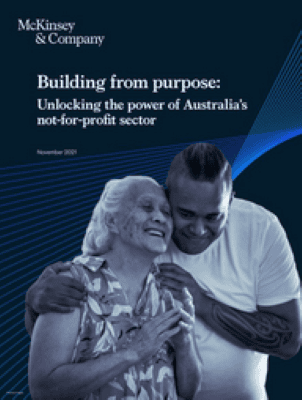
Those of us involved in the Nor-for-Profit (NFP) sector in Australia can be proud that on so many levels we are operating at world class standard. This is evidenced in the November 2021 McKinsey & Company report ‘’Building from Purpose: Unlocking the Power of Australia’s Not-for-Profit Sector” (download it here). The research involved surveying 4500 people in Australian NFPs, interviewing 100 senior leaders in the sector and comparing the results to international benchmarks composed from 800 organisations.
To put the NFP sector in Australia into context, it employs over 1.38 million people (11% of jobs) and contributes $129 billion to Australia’s economy, not to mention all the volunteer time and efforts as well. The report notes that the demand for services in the NFP sector rises in times of crisis and generally tackles those society tasks no one else wants to be involved with.
The last two years has seen the demand for services growing, but this growth has not been matched by similar growth in supply, and is required to meet increasing complexity surrounding reporting, compliance and governance, all within a Covid-19 context.
At the same time, the report notes a generally surge in ‘social ambition and entrepreneurship’ in Australia, creating an opportunity for the NFP sector to harness this.
The factors identified in the report where Australian NFPs are particularly world class are:
Expanding on this, the report then notes that the healthiest NFPs in the study have the following three essential capabilities:
Finally, the authors propose 10 ‘bold, cross-sectional ideas’ for enhancing the sector. The report is worth downloading, and the ideas are applicable not just to Australian NFPs, but those in any jurisdiction.
Consider how your NFP compares to these characteristics, and that strategies you might implement to take your organisation to the next level.
Are you ready to start your MBA (Master of Business Administration)?
An MBA will help you progress in your career by providing advanced training in the practical, ethical, and moral dimensions of leadership.
Here's why you should study your MBA at Avondale:
There are still spots available to start your MBA in March 2022.
| DOWNLOAD COURSE GUIDE |