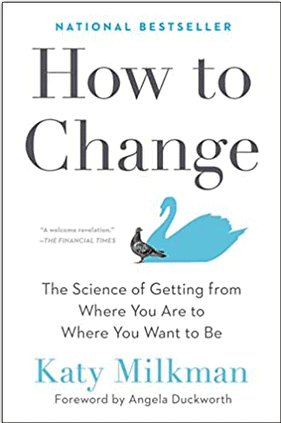
Finally, someone has been brave enough to address the fact that my problems are not the same as your problems and require a unique solution! Dr Katy Milkman, in her 2021 book How To Change (find it here), recognises that to overcome the particular challenges we each face, we need to develop strategies tailored to our circumstances – there is no one-size-fits-all solution.
This is an incredibly well researched book that is supported with ample evidence yet is full or relatable stories that illustrate the key principles, making it an easy personable read. Rather than being some self-help book, Milkman has provided a set of tools that can be used to address change at both the personal and corporate level.
Each chapter focusses on an obstacle that stands in the way of success, helping th reader to recognise them and providing some suggestions on how to deal with them, noting that small changes accumulate into big results. Of particular interest to me was the recognition that my impulsivity can cause me to procrastinate on useful tasks and to identify what is causing me to not follow through on my good intentions. Thankfully there are suggested strategies I can choose form to work through these. While I recognize that laziness can be a major hinderance to effective change, I was surprised by the findings that too much rigidity can be just as bad, which helped explain a few failures from the past.
This book is highly recommended for anyone that is wanting to make and sustain change. Leaders would benefit not just personally, but also in understanding how they can help others through change as well.
What makes someone influential inside an organisation? What are the mindsets and practices that differentiate the most impactful players from others on a team? How do contributors influence their leaders and build organisational support for their ideas and initiatives without having positional authority? Are these skills learnable? This was the challenge author Liz Wiseman set her self and answered in her book Impact Players (2021, Harper Business).

Impact players are defined as “players who make a significant contribution individually but who also have an enormously positive effect on the entire team.
Previously a highly successful corporate executive, now a management researcher, Wiseman is considered one of the world’s top management thinkers. She undertook an extensive research project identifying impact players, and then spoke with them, their managers, and their teams, to find out what are the characteristics that make them impact players.
The result is a book full of tools that will help you develop leadership at all levels, increase employee engagement, and develop the mindsets that bring out the best in people and organisations. It is hard to argue with such a well-researched approach and presented book, that is very well written and easy to follow. It carefully identifies what it is that makes high impact players, and then explains how to use these to develop yourself and/or your teams.
This book will appeal to all leadership forms, both new and established, as well as parents and teachers. It is highly recommended.
“Teamwork makes the dreamwork”, or so they say. New research reported in a recent Knowledge@Wharton online article (read it here) challenges the belief that teams are always the best option for getting things done. Their findings indicate that it is more about the complexity of the task at hand. “Simple tasks are best accomplished by individuals, while difficult ones are more efficiently completed by a group.”
Interestingly, when tasks are complex groups are more efficient than an individual, and usually just as fast. But simple tasks are best tackled by individuals. Some of the reasons for this is because teams “generates more solutions, they generated faster solutions, and they explored the space of possibilities more broadly.”
The researchers did take into account the potential for negative group dynamics and managed to circumvent this by assigning “a group leader who can keep everyone moving in the right direction.”
The implications for managers is to think about the degree of complexity of the task involved, and to then assign it to either a team or an individual in order to get the matter addressed as efficiently and speedily as possible.

My tastes and buying preferences are very different from my parents. My daughters are very different to mine, and I am seeing that my grandkids are different again. The implications of that involve entities having to adjust they way they market to these groups. And to make it worse, my preferences and expectations have changed over time as well. How can organisations possibly know how to plan their marketing strategy in such a dynamic context?
Thankfully Deloitte Insights has just published their report ‘2022 Global Marketing Trends’ (Read it here) which provides guidance on what is looming, and what organisations should be doing to meet the changing needs of consumers. The report is based on thousands of surveys across the globe. Spoiler alert: “Consumers expect more tailored and personalised experienced, but simultaneously are more guarded about how their data is captured and deployed.”
The advice from Deloitte? “…holistically rethinking the way brands engage with customers.” The evidence supports this, with brands with 10% or higher annual growth “…comprehensively addressing the entire customer experience – encompassing everything from activating an enterprisewide purpose to overhauling entire customer data strategies.”
The report is packed full of examples and ideas to help you reorient your marketing strategy, and it is built around three sections that follow, along with some ideas (each of which has their own chapter in the report):
1.Putting people at the centre:
2. Building the data infrastructure
3. Designing dynamic experiences:
I have barely done the full report justice with this brief snapshot, and it is highly recommended you download it and use it as a discussion starter with your marking team to see how you can prepare for the coming changes.
The concept of employee experience is now a major theme in current business thinking and is seen as a key for organisations to be successful into the future. Reasons for the growth in this idea include generational change in the workplace, learnings from operating during Covid, and changing societal expectations.
It occurred to me recently as I was reflecting on the latest reports and findings that there are three common elements that keep cropping up in this area of conversations: Purpose, Authenticity and Resilience. Further, these factors, along with Employee Experience (EX) are all interconnected, and when all four combines, organisations have the highest chances of success.
Purpose: This is the “Why” for organisations of what they do and gives meaning and legitimacy to it. It is the contribution they are making to society by being net givers rather than takers. From this accrues respect.
Authenticity: Integrity, accountability and transparency are key elements of this component, where the organisation ‘walks the talk’ of its why. Trust is the fruit of authenticity.
Resilience: The organisation does not “cut and run” but is there for the ‘long haul’ because the organisation is adaptable in response to organic changes rather than succumbing to fads and cares about sustainability. Loyalty is earned through this.
The research is very clear that creating a positive employee experience is a key factor in organisational success, and when these foundational elements are evident and thriving in an organisation, they combine to create and enhance a positive employee experience, as depicted below:

Where these conditions exist in organisations, the purpose reminds employees that they are contributing to a higher purpose more than just profits, generating pride and respect and allows employees to align their own purpose and values with those of the organisation. When the organisation and its leaders model authenticity by living the values and holding others to those standards, employees know they can trust the organisation and its leaders, even when tough decisions need to be made. By having a history of resilience, employees understand the organisation will only adapt to remain true to fulfilling its purpose into the long run, earning their loyalty, and reducing employee turnover.
This perfect storm of elements creates the environment for organisations to become significant, sustainable, and successful.
Politics is not always a dirty word. My trusty Oxford Dictionary has many definitions for it, most to do with the actual science of governmental politics, but it also defines the word as “activities concerned with the acquisition or exercise of authority or status.” With this comes many connotations of dodgy dealings, deceit, and deception in order to manipulate situations for one’s own advantage. And while this does happen, every day we all exercise authority in one way or another, and for the most part, with good intent.
With that background, a recent article caught my eye ‘The Politics of Influence in Top Management Team Meetings’ (Read it here) and I was very curious what direction it would take. The article reports on some research released earlier this year that analysed the interactions between the CEO and the other members of top management teams, noting how influence was used (in the good sense of the word politics).
The research found that rather than influence being based on longstanding alliances, “coalition-building in TMTs can also be in-the-moment and fluid”, which means members can form temporary coalitions with different members for each issue under discussion. This counters much of the research to date that highlighted it was pre-existing alliances that were dominant.
Five kinds of interaction patterns between the CEO and TMT members were discovered as follows:
For each of these interactions, the article gives some practical advice on how to address or handle the situation at hand in order to deescalate any issues and facilitate an effective meeting.
What is important from this research is that these interactions can come and go throughout the meeting and that consequently the decision-making processes are much more dynamic. This means that how people use their influencing behaviours matters, and that tone of voice and body language play important roles. People who “can relate well and demonstrate situationally appropriate behaviour in a manner that inspires confidence and trust will get their way.”
This is an interesting and practical article that challenges established thinking for anyone involved in meetings.
It’s back again…December. The most wonderful time of the year! Wonderful yes, but often very busy. There are work projects to finish, tasks coming in that simply have to be done before Christmas, personal holiday preparations, and of course there are the Christmas parties. On occasion the work Christmas party can feel like just another item on the to-do list, but they are not a waste. In fact, events like the Christmas party are an important part of the employee recognition and appreciation toolbox.
It is well established that happy and engaged employees produce better business outcomes. As Chandler McLeod points out in this article, the Christmas party benefits organisations in several ways:
Coming together as a company at the end of the year provides an opportunity to take a collective breath, reflect on and celebrate the year that was, and express gratitude. After a year like 2021 and the personal and professional challenges we have all faced, this is more important than ever. Let us stop for a moment and to recognize and appreciate the people that are part of our organisations. Recognize means you acknowledge what they have done, their external efforts. Appreciate means you acknowledge who they are, their inherent value. Taking that opportunity to say “I see you” and “I am grateful for you” is incredibly powerful for the receiver, both as an employee and a human being.
Gratitude at work can be expressed at three levels, this article from HRD outlines. The first is episodic gratitude, which is your unique moments usually stemming from specific events. As these episodes of gratitude are witnesses more consistently the second level persistent gratitude emerges. Here, a person begins to view the world through a generally more grateful lens. The third level, collective gratitude, means it has become a defining feature of the organisational culture itself.
While the workplace Christmas party provides an opportunity to reinforce gratitude at all three levels, it is just one event in the year. Celebrating people for who they are and what they do is a year-round event. We need not wait until December each year to celebrate our wins and to reflect on how grateful we are to have reached this point. Instead take time regularly to do this and turn it into a culture of celebration and gratitude.
It’s happening again. Organisations are facing another back-to-the-office transition after months of working from home. But as our team members return, they are likely to be different versions of the people who left. After adjusting their workstations, wardrobes and routines, some will be rejoicing at returning to normality but others will be exhausted at yet another change.
For in-depth suggestions on how to navigate returning your employees to the office, read this article, which recommends simply being flexible. Recognise everyone has different emotional metabolism. We process change differently. Some of your team members may be excited to return to the office and interact with colleagues again. Others may be experiencing change fatigue and a sense of anxiety at having to share space, for example.
It’s important to understand things will not simply revert back to what they were previously. Employees have had unprecedented levels of autonomy while working from home, setting their own schedules, deadlines and processes to a large extent. Many have come to value this to such a degree that they’re willing to leave their current employers if forced back into the traditional top-down approach. Research supports this by demonstrating that when employees are treated and trusted like autonomous adults, performance and engagement levels increase. Perhaps this warrants more of an outcomes- rather than task-focussed approach. Yes, organisations still need jobs completed to certain standards, but there’s often various ways of achieving these outcomes.
As your team members return and you begin to create a new sense of normal, there are bound to be some bumps in the road. These may present as an initial dip in performance, fluctuating emotions or new behaviours such as using headphones to create the illusion of solitude. It’s OK. Your team members are readjusting to working alongside others again. Acknowledge the the need for added support and perhaps the setting of new boundaries to help with re-building the team.
Speaking of team building, now may not be the time to launch into the well-intended team bonding day. People have been juggling months of team bonding while sharing home offices with their spouse, homeschooling their children and trying to remain civil while doing so. Focus instead on team connection: a mutual understanding and support for each other. Such a connection will provide a safe space for open communication around what each team member needs, setting new expectations, potentially grieving the loss of the old normal and navigating into a new normal.
With so much information coming at leaders about what they should be doing next, it can be difficult to distill what is actually important. Just released by McKinsey & Company is a very helpful comprehensive report that has surveyed and interviewed leaders and executive across the globe and spectrum of industries.
The ‘What Matters Most? Five priorities for CEOs in the next normal’ report (Read it here) notes that moving forward, it is obvious leaders “need to do more than fine-tune their day-to-day tasks; they need to be ready and willing to rethink how they operate and even why they exist.” Their advice to leaders is to “step back, take a breath, and consider a broader picture.” This is great advice. The report looks at the five priorities for the “next normal” as identified by the worldwide pool of leaders they spoke with.
This is quite a long report, but while being comprehensive, it is full of very practical ideas as to how leaders and executives may think about and implement these priorities. It is also important to understand that how these are implemented “will vary from company to company; some will me more important than others”, but the key is that mastering these five priorities will substantially improve the odds of success.”
As I read the report, I thought it would be a great discussion point for leadership teams over a series of strategy sessions. Each session could consider one of the priorities and how your organisation might impellent it best. Or it could form the basis of discussions during a leadership retreat. How is not important, what is most important is that you actually consider them.
The five priorities, with a very brief synopsis are:
This report provides a blueprint for organisations that want to be prepared for the next normal. Ignore it at your peril.
We hear a lot of lip service about how employees need to be involved in the change process, especially when it involves changing organisational culture. But when is the best time to involve them? A recent article from Knowledge@Wharton (read it here) reports on a major research project that trialled this in a food processing plant. The results are very interesting.
As noted in the article, “supervisors are more effective at guiding change early in the process, when there is greater uncertainty and confusion about the new standards of behaviour, while peers are effective later in the process, when the standards are better understood by everyone.”
The focus of the research was on organisational citizenship, which they explain is “a range of behaviours that promote the social environment of the workplace.” Providing several examples, the authors note that such behaviours are not always “codified” which means it can be hard for newcomers to understand what the behaviours are and what is expected of them in the workplace.
Key to the success of such plans is repetition and practice. It centres on “creating, communicating, and implementing interventions – then measuring their impact.” But it is the timing of these interventions that is key, with supervisors being most important at the beginning, and then ceding control to the employees. That is the tricky part – knowing when to hand it over to employees. Essentially the advice is to give them a chance, and then use minor encouragement and adjustments to correct until such time as they take ownership.
This article gives another good perspective on implementing change and is well worth considering in your next change management attempt.