Change programs rarely deliver as promised, at least in my experience. There are plenty of reasons for this, but a recent article in strategy+business by Elsbeth Johnson entitles ‘Lazy Leaders and Heroic Managers’ has captured the real essence for this (Click Here To Read).
The article is based on a four year study Johnson undertook on change initiatives, and she poke with both the leaders who conceived the change, and the managers who had to implement it. Her conclusion is that all too often the managers were heroic in their efforts, while the leaders were lazy. By lazy, she means the leaders were doing the easy things and not the right things.
Johnson bills the problem down to three ways that leaders tend to fail the change process:
Essentially, Johnson emphases that leaders, when thinking about launching a change program, need to invest their time into the difficult tasks of having a clear idea of what the program is to deliver (outcomes), allocating the resources to support this (resourcing), and then relentlessly sending consistent signals over the long term (signalling).
If you would like to give your next change initiative the best chance of success, ensure you read this article and integrate its ideas.
If your employees are engaged research shows that your company performance is going to improve, your employees are 87% less likely to leave the company, and revenue growth will improve. These finding come from research undertaken by Slack, who surveyed over 9000 knowledge workers and managers across the globe. The Future Forum report entitled ‘Flexible, Inclusive, and Connected’ can be downloaded for free here. The report concludes that “doing well by employees generates better results for companies”.

We have picked out a few highlights from the report for you, but strongly recommend that you read the whole report. One thing the report really makes clear is that most employees do not want to recert to how things were pre-covid. Employees have been found to be as productive (if not more so) without having to be in the office.
The report identifies four key success factors:
As a teaser, we will pick out a few of the report highlights for you:
There are a number of very practical and realistic recommendations for leaders to consider implementing that will enhance the connectedness and engagement of employees. My favourite is to normalize saying no.
Once again, it is highly recommended that leaders read the full report and consider how your organization can better engage your employees.
If you haven’t already completed a psychometric test, chances are you will at some point. Far more than just the “what kind of pizza are you?” BuzzFeed quizzes, psychometric tests are objective, standardized tests that assess an individual’s capabilities, behavioural tendencies, and personality traits. Why is this helpful to businesses? Employers hope that by using these tests in the recruitment process, it will identify candidates who would likely be higher performers in the role. While it’s true these tests can help with that, before spending unnecessary time and money testing for the sake of it, think about these general principles below to ensure you are maximizing the benefits.
Most importantly, you need to identify exactly what you are trying to measure. Rather than just picking a test and hoping it will tell you something useful, first conduct a job analysis to identify the specific traits or skills that a person must possess to be successful in the role. Once those are defined, you then choose an assessment specifically designed to measure those traits or skills.
A test with high validity measures what it is supposed to measure. If you are using the test as part of your recruitment and selection process, look for tests with high predictive validity. This means the test is more likely to give you an accurate prediction of a person’s likelihood of success in the role. That is after all, the point of using these tests to begin with.
Psychometric tests should never be used on their own to make a decision, only to inform the decision-making. It is important to remember that these tests are only one tool in the recruitment toolbox, and should be considered in the context of the other tools such as interviews and reference checks. A test is only a snapshot of the person at one point in time, and simply provides you with an awareness of potential behavioural preferences, strengths and development areas.
Similar to the above point, remember that the test results are not the be-all and end-all. It is easy to read too much into results. In reality, most people will exhibit a varying range of traits in various circumstances. A result indicating one preference does not mean a person cannot work or behave in a way that is different in order to perform the role, it just means this may be more of a challenge for them.
Psychometric tests can be an extremely valuable tool in your recruitment and selection processes, provided the tool is chosen strategically, with an understanding of its purpose, and used as part of a wider toolbox.
“Millennials and Generation Zs came of age at the same time that online platforms and social media gave them the ability and power to share their opinions, influence distant people and institutions, and question authority in new ways. These forces have shaped their worldviews, values, and behaviours.”
So opens the Deloitte global 2021 Millennial and Gen Z Survey (Click here to download). This report looks at what is important to these digital natives and where their interests are. It surveyed nearly 23,000 respondents in 45 countries, completing the research in February 2021.
The report is comprehensive, but very easy to read and gives the takeaways as to what leaders and organizations need to be most aware of. For example, this group are more likely than others to hold both themselves and others accountable, especially in the areas of racism and sexism. They strongly believe in the power of individuals to create change and are also quite willing to “shun companies and employers whose actions conflict with their personal values.”
There were six key findings, a sample of which included:
Following discussion of the key findings, the report suggests five key takeaways for business leaders, two of which are:
I recommend leaders take a look at the full article and consider how you might be able to ensure strong connection with this cohort and harness their immense talent and energy.
“When a nonperforming CEO finally leaves an organisation, stakeholders often wonder why the board took so long to act.” Author Ram Charan tackles the issue of how to stop a faltering CEO from damaging your organisation in a fascinating recent article (read it here). Charan is a prominent business advisor and author (including the acclaimed book Execution) who speaks with enormous experience.

The key focus of the article is to emphasise that hesitation is counterproductive, as evidenced by his following statement “One of the most serious mistakes a board can make is to underestimate how quickly the company can decline under the wrong leadership. A faltering CEO simply cannot be allowed to stay in the job for long.”
Helpfully, the article lists a number of early warning signs that board members should be on the lookout for that the CEO may be heading into troubled water, some of these include:
The board needs to begin discussions as soon as issues are first raised, and Charan makes the point that this needs to be done “however perilous that may seem.” He makes the astute observation that “in the rest of their working lives, most board directors are strong, condent leaders, but in the context of a board, they often hold back.”
Creating a positive context for this is important, which includes making clear that raising such issues is to test the feelings of the entire board, rather than rush into action. Also, meetings that run to a too tight schedule can drive “out candour, so board leaders should reserve time for directors to air concerns.”
Importantly the key is not to delay and to continue the discussion over time until the facts are clear and “then consensus should be reached rapidly about what course of action to take: support, coach, or dismiss.”
A challenging proposition, but some very good advice from Charan for all boards, to ensure they are fulfilling their responsibility to the organisation’s shareholder.
What I learned at Kindy this week
This past week I had one of the best days of my life. It was Grandparents Day at the World’s Greatest Granddaughters’ (WGGD) Kindy class. So, my beautiful wife and I (along with heaps of other grandparents) turned up for a concert put on by the three Kindy classes, then it was time in WGGD's classroom room and finishing up with a picnic lunch on the Kindy play area. It was a wonderful day indeed!
All the kids filed into the hall for the combined concert, WGGD was scanning the crowd looking for our faces. Her vulnerability on full display, and then the reassurance and joy at seeing us there. I’ve been to a few concerts in my time, but this was the best by far, as the kids sang with so much enthusiasm and conviction. It was magnificent.
Then WGGD escorted us on a personal tour of her classroom and a little play in which WGGD was a grandma. The classroom was amazing – so different to my Kindy experience. There were not regimented rows of desks, but instead dedicated spaces for reading, learning, painting, and even a “chill out” space which was a little tent for the kids who needed a bit of alone time and have that respected by their peers. We got to meet Turbo the Turtle and Jabba the Blue Tongue Lizard – resident classroom pets. We did some reading together, painted a picture and heard all about what happens. It is obvious how much hard work the teacher puts into thoughtfully creating such warm and inviting spaces, activities and culture. It was so informative, and I wanted to come back every day.
Throughout the whole time we were at the school I was bursting with emotions – pride, love, connection – you name it. I just wanted to capture it and hold it forever.
Reflecting on that day (including watching the videos of the concert and play multiple times) it struck me that the classroom provides so much more than I first saw. It is all so carefully constructed to ensure it is a place where the kids can have connection and build community. It has spaces for dedicated learning and skill development, Turbo and Jabba provide opportunities for responsibility and caring, there is opportunity and environments for expressing creativity, and there are safe places for managing emotional and mental wellbeing.
Why can’t all organizations do that? I am well aware of the legends of places like Google and Yahoo that have all the toys and attractions, which research has since found is a great incentive to attracting new people, but actually blurs the line between work and home for existing employees who find themselves spending way too much time at work and lose balance in their lives. But what if we got the balance right and didn’t go overboard but put a bit more thought into making our workplaces safe, community building, and where we can learn and develop? Is that too much to ask?
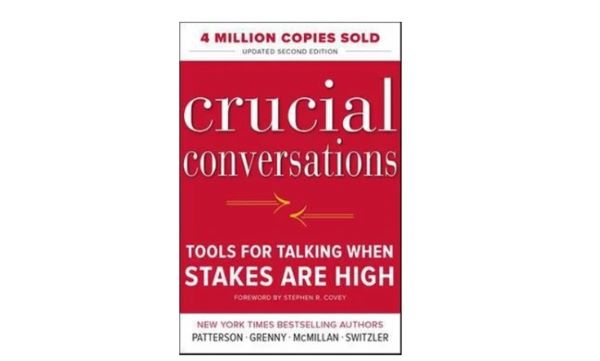
“The key skill of effective teams, team mates, parents and loved ones is the capacity to skilfully address emotionally and politically risky issues”. Such is the claim from the authors Kerry Patterson, Joseph Grenny, Ron McMillan, Al Switzler of the book Crucial Conversations: Tools for talking when stakes are high (McGraw-Hill, 2012). Although an older book, I feel this is a timeless work that needs to be exposed to the next generation of leaders.
Crucial conversations are defined “as discussion between 2 or more people where (1) stakes are high, (2) opinions vary, and (3) emotions run strong. We have three choices in how to handle this – avoid it, face it but handle it poorly, or face it and handle it well. This book gives the tools to be able to handle them well.
The authors have many years of work as consultants and trainers who have authored a number of best selling books. The book builds on over 20 years and 100,000 interviews helping people handle the crucial conversation. It is very convincing as they put into simple terms tools appear workable and achievable.
It is a really well organized book that provides a guide to being able to handle the crucial conversation and translate it into action and results. It fearlessly addresses issues like:
I like that is does not shy away from the tough stuff and addresses a number of highly charged situations like sexual or other harassment, insubordination, and sensitive personal issues (like personal hygiene!).
While this blog goes to a predominately business audience, the book gives the tools for anyone to handle crucial conversations no matter their context.
It is very worthwhile and came to me highly recommended by many people. And I in turn would like to recommend it to you.
A recent Australian Human Resource Institute (AHRI) online article outlined a recent case heard by the Administrative Appeals Tribunal of Australia (AATA) which AHRI believes “should cause HR and employers to sit up and take action”.
In the AATA case, the Tribunal ruled in favour of an employee’s worker’s compensation claim which surrounded a psychological injury which came about during a remote management work arrangement.
While the AHRI article notes that the case wasn’t the result of COVID-19 related overworking, the view taken is one that “could set a precedent for employees who’ve felt stressed and overworked over the last 16 months”.
Aaron McEwan, Vice President for Research and Advisory at Gartner, who provides strategic advisory to Heads of HR and other Senior Executives, is quoted as saying “This case could potentially be one of the most profound changes in the IR landscape that we’ve seen”. His view is presented from the perspective that not enough is being done to prevent such psychological injuries. The article notes a 10-20 year time frame where a ‘do more with less’ work mentality has meant “operating as close to the margin as possible to deliver outcomes but spreading people too thinly as a result”.
The article notes a 2020 Centre for Future Work finding which noted employees worked an average of 5.25 hours of unpaid labour each week during COVID-19 – increased from 4.62 in 2019 – and noted the figure was 6.21 unpaid hours for full-time workers. The report outlined that “based on a standard 38 hour work week, this is the equivalent to more than seven weeks of unpaid work per worker per year. Extrapolated across Australia’s workforce, this implies total unpaid overtime worked of some 2.9 billion hours per year”.
So – how can HR prevent forms of psychological injury from occurring? The AHRI article poses a few specific suggestions which are worth looking at, but the resourcing of teams is identified as needing to be a key focus. A view emerges that employers need to stop thinking of employee wellbeing as an extension of benefits, but rather, from the perspective of the need to fundamentally redesign work practices.
Specifics from the AATA case finding can be found here: http://www.austlii.edu.au/cgi-bin/viewdoc/au/cases/cth/aat/2021/1183.html
I’ve noticed a few common themes emerging in my reading and research about the challenges facing our leaders. Other commentators, based on their perceptions and industry contexts, will have different views about what these themes may be, but the following four stand out for me.
There’s no textbook answer with a five-step implementation process from which leaders can draw that address these challenges. Instead, I propose leaders adopt an approach that recognises there’s no one right way, no heroic individual, and no definitive theory. Leaders need to continually be learning and looking for new ideas—they cannot leave innovation to others. Instead, leaders would do well to:
The successful leaders from now on are those who commit to continuing their learning journey so they can develop the awareness, attitude and skills needed for this new era.
Photograph
Foto Sushi on Unsplash.
[x_callout type="left" title="Study leadership and management" message="As a business professional, you’re looking for a sophisticated set of skills and abilities to adapt to rapidly changing business environments. Organisations require effective leaders who understand the business needs of their organisations. Avondale’s Graduate Certificate in Leadership and Management will provide you with advanced training in the practical, ethical, moral and spiritual dimensions of leadership. You can study this course on its own, or use it as credit towards an MBA. We’re offering limited Commonwealth-Supported Places to Australians and New Zealanders. Securing a place will save you more than 20% on fees. Available only to full-time students who commence in August." button_text="DOWNLOAD COURSE GUIDE" href="https://mkto.avondale.edu.au/Leadership-and-Management.html" target="blank" class="x-btn-yellow"]
I have been wondering what does the post-covid office space might look like? For some it will be rather empty, with many workers opting to continue working from home. Some businesses I know have already renegotiate leases for smaller premises. Increased health requirements are necessitating reorganisation of existing spaces to ensure appropriate social distancing is available, and hygiene requirements are being met. The Covid-safe workplace is here.
A recent online article in Fast Company (click here to read it) addresses this issues using a very unique approach – they spoke to the architects (Clive Wilkinson Architects) who championed and were responsible for the open office boom in companies like Microsoft and Google. So, what do they believe about the future of office space – “the open office is dead”! While surprising, they also add that the ‘one-size-fits-all’ office is not appropriate either.
Research has shown that open offices have major problems in relation to noise, sexist behaviour being reinforced, and high employee turnover. It appears that now is the opportune time for companies to rethink and redesign their offices.
Included in the article are descriptions of three potential office spaces that compliment traditional office spaces, which provides options for employees. The three proposed spaces are known as: The Library, The Plaza, and The Avenue. Providing diverse spaces gives employees options to find the optimal workspace for them.
This article is an interesting but challenging read and will cause you to reflect on your design choices.